Riot, mob violence
Doing research tonight, I stumbled across a remarkable, primary account of the race and draft riots in Detroit in 1863. Part of the document included this poem, written by a black citizen in the city at that time:
THE RIOT.
BY B. CLARK, SEN., A COLORED MAN.
'Twas in Detroit city, the State of Michigan,
Where mob law reigned rampant, disgraceful to man,
In killing and beating both women and men,
And sacking and burning beyond human ken.
The crowd ran collected and beat every one,
Whose skin were not colored exact like their own,
And swore they'd have "Falkner," and hang him that day,
Or kill every "nigger" that came in their way.
The only pretext for this outbreak in fact,
Was "Falkner" committed an now nameless act,
Although given up to the law right away,
The mob sought to lynch him in broad open day.
Now be it remember'd that Falkner at right,
Although call'd a "nigger," had always been white,
Had voted, and always declared in his shop,
He never would sell colored people a drop.
He's what is call'd white, though I must confess,
So mixed are the folks now, we oft have to guess,
Their hair is co curl'd and their skins are so brown,
If they're white in the country, they're niggers in town.
To keep from a rescue, and take him to jail,
The soldiers were ordered to come without fail,
But they were insulted and stoned at--pell mell--
Till some of them fired and down a man fell.
The mob, disappointed, now hied to a place
Where some humble coopers, of the sable race,
Were honestly working to earn their own bread,
By rowdies were set on and left almost dead.
They enter'd, and beat them with billets of wood,
Then fired the cooper shop just as it stood,
And as they attempted to rush from the flames,
They met them with bludgeons to dash out their brains.
Then they took the city without more delay,
And fired each building that stood in their way,
Until the red glare had ascended on high,
And lit up the great azure vault of the sky.
The sight was most awful indeed to behold,
See women and babes driven out in the cold,
And old aged sires, that fought for the land,
Beat almost to death by a desperate band.
Whilst females were heard crying, "kill them"--Oh; shame,
They urged on the mob, yet there's no one to blame,
'Twas got up to please our friends of the South,
Now don't say a word--nay, don't open your mouth.
We go in for the Union just as it was.
And slavery also, and all the slave laws;
Now do not think hard if we do behave rash,
By burning those houses we pocket some cash.
'Tis said that those houses and inmates were bad,
And hence the excuse that the outragers had,
Yet was it the true love of virtue alone,
That made the mob anxious to pull a church down?
Strange as it may be, yet 'tis true without doubt,
Mobs do not discriminate if once let out;
So when they had fired the huts of the poor,
They ran with the torch to their rich neighbor's door.
This brought the community plainly to see
The danger in which all were likely to be;
The rich and the poor, the black and the white,
Stood a chance to be mobbed and burned out that night.
I blush when I think that such deeds should take place,
Not heathens or Turks, a civilized race,
Not where savage nations alone have the rule,
But here amidst churches, the Bible and school.
Humanity wept, she lamented the sight,
The groans, blood and tears of that terrible night;
Yet, oh, may the town of Detroit never see
Such a day as the sixth of March, sixty-three.
Wednesday, February 22, 2006


Sunday, February 19, 2006
The Silent Life of Photons
Days at Promontory Point
Sitting in church this afternoon, I was reminded by the light entering the windows at the base of Beacon Hill rising over the Common that I am beckoned south and west. Generally. Without doubt, I am sometimes beckoned east, sometimes north. In Chicago, I am pulled both west and east, the former out to the prairie and the grassy hills, the latter out over the lake and into Michigan. In cases of being beckoned north, this often has to do with the western light, and sometimes with cloudy weather, mostly in winter but at times and for different reasons in the summer. In winter, the western light, in late afternoon, recalls the crisp air of the northern hills where we took long weekends as children and plowed through sixteen inches of snow on our way to play on these wooded knolls. Here the western light streamed easily through the barren trees where my brother and sister and I dug in the snow and played innovative little games. When the cloudy winter light settles I am sometimes beckoned north, in recollection of that magnificent grey landscape on the same long weekends where we drove subtle curved paths through orchards and woods on our way to ski trails and country diners and sometimes haunts. In summer I am beckoned north as well, but again due to the western light, which brings vivid impressions of late afternoons when the air finally dries out and the insects settle back into the wood save the tiny bugs that hang in the air stubbornly like gumps, and when the lake water begins to cool and the hum of boat motors die down and the world and catydids are turned over to crickets and slightly breezes that come from nowhere but the stuff of night itself. Occassionally, I will be beckoned toward the north and east in both summer and winter as a result of the eastern light which is in essence (and essence) the western light minus the angles of incidence that otherwise would make it equally vibrant. the eastern light has a way in both winter and summer of morphing the landscape into the sky, blurring and erasing the horizon line or the tree line in a singular palette. Here, the moon is most silver(-set-against-blue). The same eastern light beckons me east across the horizonless lake on Chicago summer evenings. As though the city were silent save a slow-rendered soundtrack, the gnats and bugs are flickering head and brake lights up the avenue, the dotted glows of windows and the planes flying overhead, blinking red and white, into Midway and O'Hare. Time moves at a rate less than 1, the foot feels no concrete but rather a mere ground, the air is devoid of breeze and weight. Just the silent music of photons creating the western light beckoning you east, highlighting the bellies of planes and softening the textures of tree and brick, upending the road and pulling the horizon up along the dome of the sky, wrapping it up back into the sky where it fades into intensity to west at your back. One has the sense of watching pure life, without identifying names and places, objects and species. Plane is gnat is oak is brake light is stone is water is street is dome is sky is person is eye is light is west is east is north is south. Is then is now is winter is summer is hill and plain and house and forest and adult and child and teenager and geezer. When time moves at less than 1, the rest seems to accelerate, warp and collapse into a stream rushing by as you face east, west, south, north...
Chanson: TNT, His Second Story Island

Sitting in church this afternoon, I was reminded by the light entering the windows at the base of Beacon Hill rising over the Common that I am beckoned south and west. Generally. Without doubt, I am sometimes beckoned east, sometimes north. In Chicago, I am pulled both west and east, the former out to the prairie and the grassy hills, the latter out over the lake and into Michigan. In cases of being beckoned north, this often has to do with the western light, and sometimes with cloudy weather, mostly in winter but at times and for different reasons in the summer. In winter, the western light, in late afternoon, recalls the crisp air of the northern hills where we took long weekends as children and plowed through sixteen inches of snow on our way to play on these wooded knolls. Here the western light streamed easily through the barren trees where my brother and sister and I dug in the snow and played innovative little games. When the cloudy winter light settles I am sometimes beckoned north, in recollection of that magnificent grey landscape on the same long weekends where we drove subtle curved paths through orchards and woods on our way to ski trails and country diners and sometimes haunts. In summer I am beckoned north as well, but again due to the western light, which brings vivid impressions of late afternoons when the air finally dries out and the insects settle back into the wood save the tiny bugs that hang in the air stubbornly like gumps, and when the lake water begins to cool and the hum of boat motors die down and the world and catydids are turned over to crickets and slightly breezes that come from nowhere but the stuff of night itself. Occassionally, I will be beckoned toward the north and east in both summer and winter as a result of the eastern light which is in essence (and essence) the western light minus the angles of incidence that otherwise would make it equally vibrant. the eastern light has a way in both winter and summer of morphing the landscape into the sky, blurring and erasing the horizon line or the tree line in a singular palette. Here, the moon is most silver(-set-against-blue). The same eastern light beckons me east across the horizonless lake on Chicago summer evenings. As though the city were silent save a slow-rendered soundtrack, the gnats and bugs are flickering head and brake lights up the avenue, the dotted glows of windows and the planes flying overhead, blinking red and white, into Midway and O'Hare. Time moves at a rate less than 1, the foot feels no concrete but rather a mere ground, the air is devoid of breeze and weight. Just the silent music of photons creating the western light beckoning you east, highlighting the bellies of planes and softening the textures of tree and brick, upending the road and pulling the horizon up along the dome of the sky, wrapping it up back into the sky where it fades into intensity to west at your back. One has the sense of watching pure life, without identifying names and places, objects and species. Plane is gnat is oak is brake light is stone is water is street is dome is sky is person is eye is light is west is east is north is south. Is then is now is winter is summer is hill and plain and house and forest and adult and child and teenager and geezer. When time moves at less than 1, the rest seems to accelerate, warp and collapse into a stream rushing by as you face east, west, south, north...
Chanson: TNT, His Second Story Island

Wednesday, February 15, 2006
Unfolding the Accordian, then Squeezing It Back Up Again.
Idea and Ontology
I spent somewhere around four hours in the past two days trying to track down a song that I heard on This American Life. Thinking about any number of micro-dilemmas brought to course in the passing of a day, I set bow to break and dug in a virtual landscape of placelessness for an ontological cue. This post is about idea and ontology. Chords are ideas. They are measurable, discernable, recognizable and identifiable; they are finite and tangible. They are not invisible. Circumstantially, our sensate capacities come to measure, discern, recognize and identify such cues like music, and waves of fluctuating air become ideas. A single piece of music, as a deliberately considered construction, denoted on paper and executed with a different rule of measure, communicates intention. This too is discernable; intention begets consequence, begets consequence, begets consequence, and on and on until we ( I ) ruffle my whiskers and call it causality. Last night I had a conversation about altruism and justice, and it was in the end a silly conversation because the other person involved and I weren't acknowledging the words that we were dodgings by proclaiming them. Besides, it was late and I was exhausted and I wanted to sit under the flourescent lights in the studio and stare forward, sipping on the lukewarm beer that stood at hand. Justice is black and white, she said, referring to Scripture. I said yes, it is. But we know it only in greytones. I don't believe in altruism, I said. I don't believe such a complete conviction is possible--sip--we declare it isn't. We're talking around the center now. At the end of the day I don't know what God's justice is. There's no way for me to a priori determine whether God's standing on a divide hoarding the murdered into hell. I cannot do this because I only see greys, but never black and never white. Of course, she said. But you have faith that God is correct. Right, that's the temptation as well as the pain of it. Yet how can we then turn around, admitting that faith in correctness is the best we can do, and send our own into a hell of our own making? What is this nihilism? How can you stand by the exactly ambiguous with an ambiguous exactness? Is it so easy to swing back and forth between poles, and miss the dialectics of moving in between? Sip. I wanted to say that I believe in one justice because the very concept doesn't allow for duplicity, and that we don't have relative palettes of choice. Sip. But that's the paradox of Christian ontology; that we depend on the relative to know the universal. This is a melancholy of all things in parallel--greater knowing yields only the possibility for greater unknowing. A god of justice is a god of torment then, if justice is univeral and singular, but we cannot know it in such terms. The extent to which we know justice is described most essentially by the extent to which we don't know, and the extent to which we don't know is the extent to which we are exacted the torment of not knowing, of building up in an origin-less world according to what can be seen and heard and tasted and felt around us; the melancholy of all things in parallel. In such a world, we will spend skewed time digging for the ontological cue. It is a grounding, as sign measures intention, measures consequence, and consequence, and consequence, and consequence...Sip. The whole time with two hands in two poles, two ends of the arc of a swing, eyes cast down along the trajectory of in between, constantly dropping swings from the right hand to pick it up with the left, and back again. Sip.
Chanson: A Perfect Circle, Judith.
I spent somewhere around four hours in the past two days trying to track down a song that I heard on This American Life. Thinking about any number of micro-dilemmas brought to course in the passing of a day, I set bow to break and dug in a virtual landscape of placelessness for an ontological cue. This post is about idea and ontology. Chords are ideas. They are measurable, discernable, recognizable and identifiable; they are finite and tangible. They are not invisible. Circumstantially, our sensate capacities come to measure, discern, recognize and identify such cues like music, and waves of fluctuating air become ideas. A single piece of music, as a deliberately considered construction, denoted on paper and executed with a different rule of measure, communicates intention. This too is discernable; intention begets consequence, begets consequence, begets consequence, and on and on until we ( I ) ruffle my whiskers and call it causality. Last night I had a conversation about altruism and justice, and it was in the end a silly conversation because the other person involved and I weren't acknowledging the words that we were dodgings by proclaiming them. Besides, it was late and I was exhausted and I wanted to sit under the flourescent lights in the studio and stare forward, sipping on the lukewarm beer that stood at hand. Justice is black and white, she said, referring to Scripture. I said yes, it is. But we know it only in greytones. I don't believe in altruism, I said. I don't believe such a complete conviction is possible--sip--we declare it isn't. We're talking around the center now. At the end of the day I don't know what God's justice is. There's no way for me to a priori determine whether God's standing on a divide hoarding the murdered into hell. I cannot do this because I only see greys, but never black and never white. Of course, she said. But you have faith that God is correct. Right, that's the temptation as well as the pain of it. Yet how can we then turn around, admitting that faith in correctness is the best we can do, and send our own into a hell of our own making? What is this nihilism? How can you stand by the exactly ambiguous with an ambiguous exactness? Is it so easy to swing back and forth between poles, and miss the dialectics of moving in between? Sip. I wanted to say that I believe in one justice because the very concept doesn't allow for duplicity, and that we don't have relative palettes of choice. Sip. But that's the paradox of Christian ontology; that we depend on the relative to know the universal. This is a melancholy of all things in parallel--greater knowing yields only the possibility for greater unknowing. A god of justice is a god of torment then, if justice is univeral and singular, but we cannot know it in such terms. The extent to which we know justice is described most essentially by the extent to which we don't know, and the extent to which we don't know is the extent to which we are exacted the torment of not knowing, of building up in an origin-less world according to what can be seen and heard and tasted and felt around us; the melancholy of all things in parallel. In such a world, we will spend skewed time digging for the ontological cue. It is a grounding, as sign measures intention, measures consequence, and consequence, and consequence, and consequence...Sip. The whole time with two hands in two poles, two ends of the arc of a swing, eyes cast down along the trajectory of in between, constantly dropping swings from the right hand to pick it up with the left, and back again. Sip.
Chanson: A Perfect Circle, Judith.
Wednesday, February 08, 2006
Someday I Will Draw a Map of Idiocies
A journalistic note on the sublime
I have decided to post the beginning of the introduction to my term paper for an independent study I did this past semester in theory. This work shows that I am a poor critic, because I divert extensively from actually introducing the topic of the paper. And yet, I find it so impossible to resist the complexity of idiocy that such diversions help to indicate. Happy.
In the vacuum of modernism’s failed idealism, the infrastructure of the modern city is, in its global-economic situation, an infrastructure of the super-modern city. It is no mystery that the development of cities runs in tandem with the development of economies; this has always been the case. Even through tracing the history of capitalism, it is indisputable that the cities of the Renaissance thrived according to their mercantilist prowess, and colonial cities of the 18th and 19th centuries according to their locations en route between trade capitals. When capitalism latched onto the global-economic ideal, as only it could, following the trauma and opportunities of World War II, it brought with it a new idealism for the global-economic city, a step—or many steps—more ambitious than the domestic-scaled, comparatively modest union between technology and livelihood and living that Corbusier dreamt.
Within this new idealism, Corbusier’s vision matured and gave way to its natural zenith, just as capitalism gave way to a global economy, metastasizing into a deeper unity between worldwide forces and universal notions of the human condition, in which it posited the consumer as the commodity while providing the terrain for its harvesting regardless of place. Implicit with this vision is the selection and distinction of human ranks—who would do the production?; who would do the consuming?; what would be consumed?; and what are the spaces necessary to effect these relationships as necessity? In addressing these questions a hierarchy emerged within the global economy that invariably identified human geographies of control and others of ‘otherness.’ What I mean by using ‘human geographies’ is referencing the incredible link between terrain boundaries—political and, within these, social and often ethnic—and the capitalization of space. It was from the western powers that the free-market apotheosis developed, but the persistent accumulation that fed it was deployed across a different human geography, in which it could be “burned off” or incubated for future exploitation.
Rosa Luxemburg noted that “the keen dialectics of scientific analysis were required to reveal how the right of ownership changes in the course of accumulation into appropriation of other peoples’ property, how commodity-exchange turns into exploitation, and equally becomes class rule.” David Harvey, in The New Imperialism calls the link between accumulation of capital and the tactics of using it to generate more capital, accumulation by dispossession. The term can be legitimately interpreted in a number of significant ways. On the one hand, Harvey speaks of the distribution of capital across spatial absorption, such as built infrastructure and labor forces, while noting that this absorption is, to some extent, speculative in that it can reenter the market as developed capital. On the other, the term intimates at the ‘dispossession’ by capitalistic institutions of the communities on which it depends to provide resources and consumption. Moreover, this begs the ethical conundrums of capitalism that illustrate the incredible social and psychological destruction that these exploitative tactics leave in their wake, witnessing the breakdown of cultural identities large and small and the uprooting of people groups from landscapes of belonging.
It is the combination of these two aspects of Harvey’s term that interests me most, in that it understands accumulation by dispossession as the continuous seeking and reaping of new locales of resources and consumption, like a turbine that can only speed up but needs an exponentially increasing feed of locales in order to make it run at all. The resulting forces embody, in a diagram, a spherical globe of dependency, requiring that all nodes in the weave be functional lest the entire network collapse. The sustainability of such a system grows more infeasible and perilous as the weave itself expands, forcing out the institutions and practices—be they businesses or local networks—that don’t have the resources to risk in participating—even paying the admissions deposit—in such a dizzying web of interdependency. The subdivision of peoples and classes fuels the turbines necessary to generate the economic vision of the global-economic city and characterizes the spatial infrastructure from which it operates. David Harvey writes on the political components necessary for this vision in The New Imperialism. I will not write directly about these components—hegemony and neo-colonialism/imperialism—but Harvey has many insights into the social and spatial implications of global-economic idealism, and in discussing political considerations succeeds in indicating (a mere taste of) its complexity.
In the 1982 film Koyaanisqatsi, the urbanism of the modernist city is eerily compared to the architecture of a microchip. The comparison, of course, is not intended for juxtaposition; it is a very editorial sequence despite (filmmaker’s name) insistence that the film, charting the destructive will of human exploitation of resources and its social and spiritual consequences, takes no such editorial position. The global-economic city is a microchip, machine-built for transferability and mass movement across infrastructure and economy. Transferability not only of commodities and technology but of individuals as well occurs at a sublime scale—in cars, snaking through freeway corridors like whitewater canyons, and in the public domain, walking atomistically across the vast, windswept plazas of modernist urbanism in which the only place to go is the building-object at the end of plaza. Through control, there is no alternative exit route. Both instances of individual transferability contributed to the economic gerrymandering of cities, in which spatial choking assured that people, as economic entities, would be appropriately directed—the car and the plaza, two edges of the same sword.
Each worked at extremes. The modernist plaza emphasized space for individual isolation, or, in the case of the housing project, the stockpiling of family units, while the freeway provided for the safe transfer of individuals across the city (and economic) boundaries and beyond, emphasizing the networks of a depopulated infrastructure, where only the destination mattered and the transit to the terminus. It was the middle ground that was eliminated at the cost of these polarized spaces; encounters of individual to individual and the communities that they formed were routed out by these spatial control strategies. It is such small-scale, quotidian interaction that is the irrelevant breed of transferability under the guise of the global-economic city. It is increasingly castigated as a ‘sentimentality’ prohibitive of progress, development—growth—and is conceded to only in illusion—a bone thrown to desires for a vital and prolific public realm.
This effect is demonstrated in a number of American cities, both large and small. Towards this influential and hard-to-control sentimentality, the global-economic city is presenting certain strategies of deference that operate according to the social categorizations that fuel its progress. Luxury condos fronting the pre-global-economic wastelands of industry are fitted with scarcely-occupiable balconies, and global chains occupy the ground floor and street front of parking structures. The so-called (and so-marketed) “lifestyle center” animates a contrived “lifestyle” experience. Strip malls with pastiche, pseudo-nostalgic individual façades surround parking bays that open up through the exit-lane narrows to the ocean of global-economic marketing dysfunction. Yet despite the apparent sentimentality of these product innovations, the origin of their economic niche stems from localized balances of capital within the global economy—a spatio-economic instance. Entire neighborhoods in American cities are experiencing economic regeneration according to the marketability of urban lifestyle development. But much like the suburban lifestyle center, they too are terrains of accumulation by dispossession, fortifying undeveloped or underdeveloped land with excess capital in the guise of credit backed and accounted for by both development financiers and the consumers that will amass within its spatio-economic boundaries.
The irony is rarely noted. Pseudo-traditional architectural façades of pre-cast, airbrushed concrete conceal the spatio-temporal fix behind a sentimental veneer. They are not mere architectural affronts; they are façades of information—credit systems; digital networks of commerce and information tracking; identity marking and identity proof; height and weight on the driver’s license linked to blood type on the birth certificate, and the social security number on the same linked to the credit report, linked to buying power and credit limits, consumer class and marketing demographic—and façades of community—security cameras and surveillance, canned music of popular imagination and totem communality as mechanisms of the marketing psychology—and façades of transferability—so your neighbor sells you a new garment over small talk down at the boutique; its foreign creditors affirm the dispossessive stratagem of their manufacturing operations within third-world labor pools.
But even these deferences are deployed within the polar framework of control described earlier. It was the architecture of modernism and its particular and strategic place in modernist urbanism that removed the planes of individual expression and tangibility, accentuating and rather forcefully asserting the neutrality of constructed space. The posture of this neutrality is towards the propensity of the individual to inhabit to her surroundings according to the spatial modes of control that architecture facilitates. An architecture of neutral assembled spaces—both public (the windswept plaza) and private (the housing block apartment)—is one that resists the autonomy of an individual and limits her capacity to respond; it is a cap on personal volition in an environment where the architecture, both alone and within its urban framework, requires the lack of volition by its very assembly, its very purpose for assembly—to scourge the middle ground, the places of meaningful cultural interaction between individuals in what amounts to a sort of micro-localism antithetical to the spatio-economic paradox of individuality by de-individuality.
Therefore, a conception of the human condition in a theoretical or speculative sense was necessary to effect such spatio-economic strategies within the global-economic ideal. The early application of modernist dogma was, after all, a utopian application, in its purest form a dream of human liberation by the machine and the I-beam. But as suggested earlier, it was capitalism that latched onto this dream and expanded—by realizing—its scope and methodologies. Before long, the old bottom-up folk conceptions necessary for vital culture were more akin to the modernist dream in its own origin, becoming a folk tale itself, espousing the utility of humans to comply to the programmatic diagrams of dwelling and communities of dwellings within its own cultural platform. Modernism missed its historical origins and fancied itself a self-born, autonomous entity, indicated by the philosophical champions and fore-founders of modernism—Nietzsche, perhaps Kant—in assuring that history up to the apotheosis of humanity is a story of sickness and the denial of sheer autonomy and the pure will to power. Kant would remind us that phenomena are distinctly autonomous, being disjoined from any noumenal ontology.
Chanson: Air, Dead Bodies
I have decided to post the beginning of the introduction to my term paper for an independent study I did this past semester in theory. This work shows that I am a poor critic, because I divert extensively from actually introducing the topic of the paper. And yet, I find it so impossible to resist the complexity of idiocy that such diversions help to indicate. Happy.
In the vacuum of modernism’s failed idealism, the infrastructure of the modern city is, in its global-economic situation, an infrastructure of the super-modern city. It is no mystery that the development of cities runs in tandem with the development of economies; this has always been the case. Even through tracing the history of capitalism, it is indisputable that the cities of the Renaissance thrived according to their mercantilist prowess, and colonial cities of the 18th and 19th centuries according to their locations en route between trade capitals. When capitalism latched onto the global-economic ideal, as only it could, following the trauma and opportunities of World War II, it brought with it a new idealism for the global-economic city, a step—or many steps—more ambitious than the domestic-scaled, comparatively modest union between technology and livelihood and living that Corbusier dreamt.
Within this new idealism, Corbusier’s vision matured and gave way to its natural zenith, just as capitalism gave way to a global economy, metastasizing into a deeper unity between worldwide forces and universal notions of the human condition, in which it posited the consumer as the commodity while providing the terrain for its harvesting regardless of place. Implicit with this vision is the selection and distinction of human ranks—who would do the production?; who would do the consuming?; what would be consumed?; and what are the spaces necessary to effect these relationships as necessity? In addressing these questions a hierarchy emerged within the global economy that invariably identified human geographies of control and others of ‘otherness.’ What I mean by using ‘human geographies’ is referencing the incredible link between terrain boundaries—political and, within these, social and often ethnic—and the capitalization of space. It was from the western powers that the free-market apotheosis developed, but the persistent accumulation that fed it was deployed across a different human geography, in which it could be “burned off” or incubated for future exploitation.
Rosa Luxemburg noted that “the keen dialectics of scientific analysis were required to reveal how the right of ownership changes in the course of accumulation into appropriation of other peoples’ property, how commodity-exchange turns into exploitation, and equally becomes class rule.” David Harvey, in The New Imperialism calls the link between accumulation of capital and the tactics of using it to generate more capital, accumulation by dispossession. The term can be legitimately interpreted in a number of significant ways. On the one hand, Harvey speaks of the distribution of capital across spatial absorption, such as built infrastructure and labor forces, while noting that this absorption is, to some extent, speculative in that it can reenter the market as developed capital. On the other, the term intimates at the ‘dispossession’ by capitalistic institutions of the communities on which it depends to provide resources and consumption. Moreover, this begs the ethical conundrums of capitalism that illustrate the incredible social and psychological destruction that these exploitative tactics leave in their wake, witnessing the breakdown of cultural identities large and small and the uprooting of people groups from landscapes of belonging.
It is the combination of these two aspects of Harvey’s term that interests me most, in that it understands accumulation by dispossession as the continuous seeking and reaping of new locales of resources and consumption, like a turbine that can only speed up but needs an exponentially increasing feed of locales in order to make it run at all. The resulting forces embody, in a diagram, a spherical globe of dependency, requiring that all nodes in the weave be functional lest the entire network collapse. The sustainability of such a system grows more infeasible and perilous as the weave itself expands, forcing out the institutions and practices—be they businesses or local networks—that don’t have the resources to risk in participating—even paying the admissions deposit—in such a dizzying web of interdependency. The subdivision of peoples and classes fuels the turbines necessary to generate the economic vision of the global-economic city and characterizes the spatial infrastructure from which it operates. David Harvey writes on the political components necessary for this vision in The New Imperialism. I will not write directly about these components—hegemony and neo-colonialism/imperialism—but Harvey has many insights into the social and spatial implications of global-economic idealism, and in discussing political considerations succeeds in indicating (a mere taste of) its complexity.
In the 1982 film Koyaanisqatsi, the urbanism of the modernist city is eerily compared to the architecture of a microchip. The comparison, of course, is not intended for juxtaposition; it is a very editorial sequence despite (filmmaker’s name) insistence that the film, charting the destructive will of human exploitation of resources and its social and spiritual consequences, takes no such editorial position. The global-economic city is a microchip, machine-built for transferability and mass movement across infrastructure and economy. Transferability not only of commodities and technology but of individuals as well occurs at a sublime scale—in cars, snaking through freeway corridors like whitewater canyons, and in the public domain, walking atomistically across the vast, windswept plazas of modernist urbanism in which the only place to go is the building-object at the end of plaza. Through control, there is no alternative exit route. Both instances of individual transferability contributed to the economic gerrymandering of cities, in which spatial choking assured that people, as economic entities, would be appropriately directed—the car and the plaza, two edges of the same sword.
Each worked at extremes. The modernist plaza emphasized space for individual isolation, or, in the case of the housing project, the stockpiling of family units, while the freeway provided for the safe transfer of individuals across the city (and economic) boundaries and beyond, emphasizing the networks of a depopulated infrastructure, where only the destination mattered and the transit to the terminus. It was the middle ground that was eliminated at the cost of these polarized spaces; encounters of individual to individual and the communities that they formed were routed out by these spatial control strategies. It is such small-scale, quotidian interaction that is the irrelevant breed of transferability under the guise of the global-economic city. It is increasingly castigated as a ‘sentimentality’ prohibitive of progress, development—growth—and is conceded to only in illusion—a bone thrown to desires for a vital and prolific public realm.
This effect is demonstrated in a number of American cities, both large and small. Towards this influential and hard-to-control sentimentality, the global-economic city is presenting certain strategies of deference that operate according to the social categorizations that fuel its progress. Luxury condos fronting the pre-global-economic wastelands of industry are fitted with scarcely-occupiable balconies, and global chains occupy the ground floor and street front of parking structures. The so-called (and so-marketed) “lifestyle center” animates a contrived “lifestyle” experience. Strip malls with pastiche, pseudo-nostalgic individual façades surround parking bays that open up through the exit-lane narrows to the ocean of global-economic marketing dysfunction. Yet despite the apparent sentimentality of these product innovations, the origin of their economic niche stems from localized balances of capital within the global economy—a spatio-economic instance. Entire neighborhoods in American cities are experiencing economic regeneration according to the marketability of urban lifestyle development. But much like the suburban lifestyle center, they too are terrains of accumulation by dispossession, fortifying undeveloped or underdeveloped land with excess capital in the guise of credit backed and accounted for by both development financiers and the consumers that will amass within its spatio-economic boundaries.
The irony is rarely noted. Pseudo-traditional architectural façades of pre-cast, airbrushed concrete conceal the spatio-temporal fix behind a sentimental veneer. They are not mere architectural affronts; they are façades of information—credit systems; digital networks of commerce and information tracking; identity marking and identity proof; height and weight on the driver’s license linked to blood type on the birth certificate, and the social security number on the same linked to the credit report, linked to buying power and credit limits, consumer class and marketing demographic—and façades of community—security cameras and surveillance, canned music of popular imagination and totem communality as mechanisms of the marketing psychology—and façades of transferability—so your neighbor sells you a new garment over small talk down at the boutique; its foreign creditors affirm the dispossessive stratagem of their manufacturing operations within third-world labor pools.
But even these deferences are deployed within the polar framework of control described earlier. It was the architecture of modernism and its particular and strategic place in modernist urbanism that removed the planes of individual expression and tangibility, accentuating and rather forcefully asserting the neutrality of constructed space. The posture of this neutrality is towards the propensity of the individual to inhabit to her surroundings according to the spatial modes of control that architecture facilitates. An architecture of neutral assembled spaces—both public (the windswept plaza) and private (the housing block apartment)—is one that resists the autonomy of an individual and limits her capacity to respond; it is a cap on personal volition in an environment where the architecture, both alone and within its urban framework, requires the lack of volition by its very assembly, its very purpose for assembly—to scourge the middle ground, the places of meaningful cultural interaction between individuals in what amounts to a sort of micro-localism antithetical to the spatio-economic paradox of individuality by de-individuality.
Therefore, a conception of the human condition in a theoretical or speculative sense was necessary to effect such spatio-economic strategies within the global-economic ideal. The early application of modernist dogma was, after all, a utopian application, in its purest form a dream of human liberation by the machine and the I-beam. But as suggested earlier, it was capitalism that latched onto this dream and expanded—by realizing—its scope and methodologies. Before long, the old bottom-up folk conceptions necessary for vital culture were more akin to the modernist dream in its own origin, becoming a folk tale itself, espousing the utility of humans to comply to the programmatic diagrams of dwelling and communities of dwellings within its own cultural platform. Modernism missed its historical origins and fancied itself a self-born, autonomous entity, indicated by the philosophical champions and fore-founders of modernism—Nietzsche, perhaps Kant—in assuring that history up to the apotheosis of humanity is a story of sickness and the denial of sheer autonomy and the pure will to power. Kant would remind us that phenomena are distinctly autonomous, being disjoined from any noumenal ontology.
Chanson: Air, Dead Bodies
Friday, February 03, 2006
The Need for Roots
An inversion: Resurget Cineribus? Peramus Meliora
For those Latin-heads out there, Detroit's motto means "We hope for better things; It shall rise from the ashes." The more pertinent question, however, is the opposite: will it rise from the ashes? We hope so. Detroit ought to change its motto to simply: "Resurgit Cineribus?" that is, "will it rise from the ashes?" Detroit, Detroit. Some of us love to say it because it makes us feel grizzled. I've often wondered what the name sounds like to someone who didn't grow up hearing it constantly referenced. What does, for instance, 'Phoenix' sound like to me? I can answer that: it sounds like a mall ploy, a theme park, a practical joke, a corporate marketing concoction, and a fake. What the world is seeing--willingly, this time, thanks to the endless parade of mindless but voluntary hype--is that Detroit is none of these things. I grew up with Detroit in my life. Aside from visiting fairly frequently (with respect to my peers), I knew that my history had roots in Detroit; important roots. What kills me is the polarity of the thing. Through and through, Detroit is a city all about and constitutive of polarity. Not even considering the obvious wealth, race, landscape, and economic polarities that Detroit maintains even within itself, I am torn between acknowledging the dismal dysfunction of the entire metropolitan clusterfuck and the meaningful tangibility of both its triumphs and its decay. And, of course, I have the polarity of nostalgia. Ladies and Germs, someday I will write an essay, or a book, entitled "In Defense of the Sentimental." In it, I hope to articulate what I cannot now, as I fall asleep writing this poorly written entry. That is that nostalgia matters, it is real dammit. Sentimentality is required reading. Did I have beer tonight? No, but maybe I should have. Gonna git a whippin from the school marm if you don't do the reading. Detroit's embarrased (embarassed?) itself so profoundly already. One big happy show. Happy, happy, charade. No cars in Motown. Isn't that ironic, like stupid Danny Liebeskind. Better than belligerant (belligerent?) Zaha. ZAAAAHA. Oh man, I think I'm giong to go to sleep. Here's an experiment: I'm going to doze off and type what I dream. Ready? Big boy and dad driving by the car dealiership in rochester. ah this only partly worked. you can feel your brain stimulated when you have to suddently do somethign conscious when youtr'e otherwise only semi so.
For those Latin-heads out there, Detroit's motto means "We hope for better things; It shall rise from the ashes." The more pertinent question, however, is the opposite: will it rise from the ashes? We hope so. Detroit ought to change its motto to simply: "Resurgit Cineribus?" that is, "will it rise from the ashes?" Detroit, Detroit. Some of us love to say it because it makes us feel grizzled. I've often wondered what the name sounds like to someone who didn't grow up hearing it constantly referenced. What does, for instance, 'Phoenix' sound like to me? I can answer that: it sounds like a mall ploy, a theme park, a practical joke, a corporate marketing concoction, and a fake. What the world is seeing--willingly, this time, thanks to the endless parade of mindless but voluntary hype--is that Detroit is none of these things. I grew up with Detroit in my life. Aside from visiting fairly frequently (with respect to my peers), I knew that my history had roots in Detroit; important roots. What kills me is the polarity of the thing. Through and through, Detroit is a city all about and constitutive of polarity. Not even considering the obvious wealth, race, landscape, and economic polarities that Detroit maintains even within itself, I am torn between acknowledging the dismal dysfunction of the entire metropolitan clusterfuck and the meaningful tangibility of both its triumphs and its decay. And, of course, I have the polarity of nostalgia. Ladies and Germs, someday I will write an essay, or a book, entitled "In Defense of the Sentimental." In it, I hope to articulate what I cannot now, as I fall asleep writing this poorly written entry. That is that nostalgia matters, it is real dammit. Sentimentality is required reading. Did I have beer tonight? No, but maybe I should have. Gonna git a whippin from the school marm if you don't do the reading. Detroit's embarrased (embarassed?) itself so profoundly already. One big happy show. Happy, happy, charade. No cars in Motown. Isn't that ironic, like stupid Danny Liebeskind. Better than belligerant (belligerent?) Zaha. ZAAAAHA. Oh man, I think I'm giong to go to sleep. Here's an experiment: I'm going to doze off and type what I dream. Ready? Big boy and dad driving by the car dealiership in rochester. ah this only partly worked. you can feel your brain stimulated when you have to suddently do somethign conscious when youtr'e otherwise only semi so.
Wednesday, January 25, 2006
Snow in East Court Cambridge
Kleines Requiem

Chanson d'installation: Waterdeep, On a Night that Felt Outdated

Chanson d'installation: Waterdeep, On a Night that Felt Outdated
Thursday, January 19, 2006
Melancholy of the Unrequitted Will
Weaving and unweaving the hostility of submergence
Returning home to a community-less shell, I became convinced yet again--just in case I still could have been making it before--that Northeasterners have no capacity for environmental awareness. Standing in the bookstore this evening, seven or eight people passed in front of me while I was searching for books without any utterance even close to "excuse me" or "pardon." Out on the street, I dodged them walking in the other direction, and halted my step when they merged in front of me. Of course, I'm a victim too. I don't really know where I am; only that I stepped from a plane sometime around three desensitized by the last four weeks and the last four hours. It was through a blanket of clouds that the midwestern landscape faded into white and greyness, just as it was through a blanket of clouds that it emerged back in December. That was four weeks ago. Four hours before I worked my way through a jetway maze and into the low-slung concourse at Logan, a story six years long was still unwinding in a web of obscure plot mutations, hop-scotch settings like in dreams, tangential contrails of subject matter that emerge and disipate and re-emerge, and the intangible gut-wrenches of memory. I wrote four hours before that we were in a time that moved like tectonic plates, inches by inches. This referred to a community that existed when the great storyteller of human tragicomedy began to weave this tall-tale. All that is left is to nod and offer stupified congratulations--hallow, without both sentiment and comprehension. This is not a gesture of dwelling on and on or suddenly snuffed-out hopes; instead it is the flash of green that lore claims is emitted with the last of the sun when it ducks under the horizon; or the subtle and temporary slip of a major seventh that renders a chord ambiguous and solidly unsure; or the long exhaulation after holding your breath. In other words, the end of the story isn't about the antagonist (towards whom the epic turns to make her the protagonist), nor is it about the retrieval of dead hopes or haunting nostalgia. Instead, it is simply about the passage of time, and the recognition that it has run out for this story. All stories require testament; they require the witnessing of their treads; they require vigil, and they require the passing of the last drip of wax that falls onto the landscape, and the terazzo floor, and the microscopic drip of ink that pen upon a pad the last words of the story: "what was it that made you hold on in the face of such despising?" This is what I have come to call the melancholy of the unrequitted will. In the end, nobody can be sure it's anything more than just the weaving and unweaving of two opposing, stubborn fictions.
Chanson d'installation: Red House Painters, Revelation Big Sur, and Grandaddy, Underneath the Weeping Willow

Returning home to a community-less shell, I became convinced yet again--just in case I still could have been making it before--that Northeasterners have no capacity for environmental awareness. Standing in the bookstore this evening, seven or eight people passed in front of me while I was searching for books without any utterance even close to "excuse me" or "pardon." Out on the street, I dodged them walking in the other direction, and halted my step when they merged in front of me. Of course, I'm a victim too. I don't really know where I am; only that I stepped from a plane sometime around three desensitized by the last four weeks and the last four hours. It was through a blanket of clouds that the midwestern landscape faded into white and greyness, just as it was through a blanket of clouds that it emerged back in December. That was four weeks ago. Four hours before I worked my way through a jetway maze and into the low-slung concourse at Logan, a story six years long was still unwinding in a web of obscure plot mutations, hop-scotch settings like in dreams, tangential contrails of subject matter that emerge and disipate and re-emerge, and the intangible gut-wrenches of memory. I wrote four hours before that we were in a time that moved like tectonic plates, inches by inches. This referred to a community that existed when the great storyteller of human tragicomedy began to weave this tall-tale. All that is left is to nod and offer stupified congratulations--hallow, without both sentiment and comprehension. This is not a gesture of dwelling on and on or suddenly snuffed-out hopes; instead it is the flash of green that lore claims is emitted with the last of the sun when it ducks under the horizon; or the subtle and temporary slip of a major seventh that renders a chord ambiguous and solidly unsure; or the long exhaulation after holding your breath. In other words, the end of the story isn't about the antagonist (towards whom the epic turns to make her the protagonist), nor is it about the retrieval of dead hopes or haunting nostalgia. Instead, it is simply about the passage of time, and the recognition that it has run out for this story. All stories require testament; they require the witnessing of their treads; they require vigil, and they require the passing of the last drip of wax that falls onto the landscape, and the terazzo floor, and the microscopic drip of ink that pen upon a pad the last words of the story: "what was it that made you hold on in the face of such despising?" This is what I have come to call the melancholy of the unrequitted will. In the end, nobody can be sure it's anything more than just the weaving and unweaving of two opposing, stubborn fictions.
Chanson d'installation: Red House Painters, Revelation Big Sur, and Grandaddy, Underneath the Weeping Willow
Monday, January 02, 2006
On the Renewal of Cities
Revival is not Re-creation
There is talk in cities all around Michigan today of renewal. It is a product of 90's oil and tech-boom optimism, when the society was invigorated by the end of the Cold War and could now think about cultural diversity, social issues, the environment (remember how enpassioned Earth Day celebrations were in the 90's), and other things that came with the ease of a blossoming globalism. In these years, people and the business world realized that our cities were embarassingly decrepit and that it might be nice (or profitable) to do something about it. Of course, now that globalism has had its way with us, the socio-economics of the 90's optimism of renewal is coming into being. Today, "renewal" of our cities is about shipping in a whole new population--one that can afford manicures, organic foods, cashmere cardigans, season tickets to the opera, and those cute demi-SUVs that perkily dodge the real issue. The vocabulary of plans--plans for renewal, plans for the downtown, plans for the economy--is one built on phrases like "luxury condos," "lifestyle center," "town plaza," "lofts," "urban residences," "cosmopolitan," and "upscale." The worst and most telling of these is 'upscale.' The reality is, no developer or city leader has any faith in a development that is /not/ 'upscale.' There is talk in Lansing of a new condo development that is supposed to "revive the downtown," according to an article. Aside from the obvious daydream absurdity that a single development can fix a city's central core (which will make the /whole/ city a shiny happy place again, right?), the most glaringly what-wha moment of this charade is the question of renewal for whom? If a city banks on 'upscale' condo developments with 'upscale' galleries and 'upscale' boutiques and 'upscale' restaurants and 'upscale' markets and 'upscale' cafes for renewal, how can renewal occur for a city of 130,000 people? Or is it renewal for the 58 people who manage to buy a 200,000 dollar condo and happen to occassion the new day spa every so often on the weekends? What could does a day spa or a fine clothier do for the GM factory workers laid off last month when GM closed an entire plant in Lansing? The problem is that governments and developers now talk about renewal in terms of kinds of spaces, in terms of building appearance (a cartoony sort of pseudo-quaint converted warehouse chic), and in terms of 'upscale' activities and perks. But this isn't renewal, this is re-creation. This is the totem black speaker at the Republican National Convention, the awnings installed on abandoned hotels in downtown Detroit for that convention in 1980, the yellow ribbon decal on the soccer mom's SUV that says "Support Our Troops," the suburban west-Michigan Christian family's Adopt-An-African boy, the Harvard Athletics sweatshirt. It's a charade, a totem; but not reality, not the tangible meat of the dilemma, not even a near conception of the crisis that it mockingly only passively refers to. Cities cannot be revived by importing archetype characters. Hipsters in the cafe do not fix failing schools, and Bougies in the day spa do not fix landlord slums or the street lights. Renewal isn't about importing court jesters, it's about repairing the existing.
There is talk in cities all around Michigan today of renewal. It is a product of 90's oil and tech-boom optimism, when the society was invigorated by the end of the Cold War and could now think about cultural diversity, social issues, the environment (remember how enpassioned Earth Day celebrations were in the 90's), and other things that came with the ease of a blossoming globalism. In these years, people and the business world realized that our cities were embarassingly decrepit and that it might be nice (or profitable) to do something about it. Of course, now that globalism has had its way with us, the socio-economics of the 90's optimism of renewal is coming into being. Today, "renewal" of our cities is about shipping in a whole new population--one that can afford manicures, organic foods, cashmere cardigans, season tickets to the opera, and those cute demi-SUVs that perkily dodge the real issue. The vocabulary of plans--plans for renewal, plans for the downtown, plans for the economy--is one built on phrases like "luxury condos," "lifestyle center," "town plaza," "lofts," "urban residences," "cosmopolitan," and "upscale." The worst and most telling of these is 'upscale.' The reality is, no developer or city leader has any faith in a development that is /not/ 'upscale.' There is talk in Lansing of a new condo development that is supposed to "revive the downtown," according to an article. Aside from the obvious daydream absurdity that a single development can fix a city's central core (which will make the /whole/ city a shiny happy place again, right?), the most glaringly what-wha moment of this charade is the question of renewal for whom? If a city banks on 'upscale' condo developments with 'upscale' galleries and 'upscale' boutiques and 'upscale' restaurants and 'upscale' markets and 'upscale' cafes for renewal, how can renewal occur for a city of 130,000 people? Or is it renewal for the 58 people who manage to buy a 200,000 dollar condo and happen to occassion the new day spa every so often on the weekends? What could does a day spa or a fine clothier do for the GM factory workers laid off last month when GM closed an entire plant in Lansing? The problem is that governments and developers now talk about renewal in terms of kinds of spaces, in terms of building appearance (a cartoony sort of pseudo-quaint converted warehouse chic), and in terms of 'upscale' activities and perks. But this isn't renewal, this is re-creation. This is the totem black speaker at the Republican National Convention, the awnings installed on abandoned hotels in downtown Detroit for that convention in 1980, the yellow ribbon decal on the soccer mom's SUV that says "Support Our Troops," the suburban west-Michigan Christian family's Adopt-An-African boy, the Harvard Athletics sweatshirt. It's a charade, a totem; but not reality, not the tangible meat of the dilemma, not even a near conception of the crisis that it mockingly only passively refers to. Cities cannot be revived by importing archetype characters. Hipsters in the cafe do not fix failing schools, and Bougies in the day spa do not fix landlord slums or the street lights. Renewal isn't about importing court jesters, it's about repairing the existing.
Friday, December 02, 2005
On Memorials
A contrast
It was brought to my attention today by a friend in the studio that Daniel Liebeskind, the new starchitect forger of the World Trade Center master plan, is the figure of a new round of anecdotes highlighting his absurdity. My friend mentioned a 9-11 memorial just finished by Liebeskind in France that takes it conceptual origins from the prophesies of Nostradamus, who, according to Liebeskind's esoterics, predicted 9-11. The same sort of games are occuring here in the US as well, and it's important to frame these currents within their appropriate categories of charades.
Viewing renderings (the flashy computer illustrations of a proposed building or space) of the new 'Freedom Center' I was struck by the thesis of mourning that is evident throughout. The people illustrated in the renderings are mostly shown in postures of reflection or mourning--dropped shoulders, flowers in hand, etc. This is a hilarity, of course, because the architects responsible for the renderings are characterized by two primary different modes of oblivion, which I would like to mention here:
1. Fetish of the icon
Architects, for all their intelligence, are not bright people. They are near-sighted individuals for the most part, who tend to be products of cultural rootlessness or phenomenological-historical identity rebellion (that is to say, they have no tangible conception of who they are that can stand alone and therefore requires a constant state of rebellion to, in essence, assume an identity by railing against identity. Such recursive infinite loops are not only logically bleak but they tend to stem, I have observed, from bored childhoods and the escapism that relativism provides insecure teenagers in the post-modern and third-wave modern world--a world that I might describe with the metaphor of satellites floating in random space, refusing direct contact but arbitrarily floating around an ether of vacuousness). As a result of this phenomenological-historical identity rebellion, the architects that designed the Freedom Center (part of a vain of architects called 'The Vanguard' to which Harvard continues to make significant contributions) have no sense of a.) subtlety, b.) narrative, as in continuity, c.) cultural synthesis, or d.) the logistics of cultural myths. That is to say, they create self-standing, self-referential, self-assertive icons that have nothing to do with anything but stake their origin in esoteric, ephemeral characterizations and conceptual obejcts such as 'The Park of Heros' or 'the Wedge of Light' or 'the Freedom Center' or 'the Fountain of the Absent Void.' Who the hell knows what this stuff means. So you see here that icons such as 'The Freedom Center,' due to its inchoate and unclear purpose, depend strongly on cultural myths, such as the idea of 'freedom.' This is not to say that 'freedom' is not a viable concept, but it is to say that it is an ephemeral concept that no building can encapsulate, but is instead a term tossed around by sycophants like the President to exploit votes and gain support of Americans that cling on the stirring cries of 'freedom' in response to the myth that anyone who professes the world lives in an enlightened state of true bliss, liberty, honor, and righteousness (who then return to their cheaply-made unregulated trailers that are invariably built over toxic streams of mining operations runoff from which they will draw mercury water to wash down the Stouffers microwavable, mass-produced, synthetic dinners. This is what I mean by the 'myths' culture, which, in order to address, architects use logistical gimmicks such as flag iconography, programmatic fillers such as a 'hall of reflection' or 'rooms of hope' in order to simply put people /somewhere/ in the massive space allocated for a 'Freedom Center' which gives no implicit guidance or rule because it depends on an ephemeral, contrived concept and a myths of dummied-down popular culture.
And this is where cultural synthesis comes in. Cultural synthesis is relating new spaces and buildings to the stories of the landscapes and architectures that surround a given space. But because too many architects are interested in creating self-referential icons, the possibility for true cultural synthesis is next to none. I think of an example in New York such as the Met. It is a monumental, dignifying building that speaks to its somewhat intrusive location at the edge of Central Park by voluntarily confining itself to the privilege of resting on Central Park real estate. This is in contrast to efforts today, such as in the siting of the Freedom Center downtown, which simply adapts a basically modernist plaza to infill the self-referential, iconic box that is the builidng itself. Because we have, to some small degree, learned from our mistakes and the empty, wind-swept modernist plaza is no longer acceptable as an architectural, urban, social, or environmental typology, architects now correct the issue by adding trees. Okay--this is a step in the right direction, but it doesn't change the fact that the plaza is still devoid of content. In fact, trees, just obscure the fact. It's better to have a tree-less, windswept plaza to make the icon as clear as possible, than to drop trees into the same concrete ocean that would manage to actually make the space less inhabitable, foster more places for the dubious freedom haters to hide--waiting to take your freedom--and make render the building an unintuitive sort of awkwardly looming chunk of mass out beyond those trees--somwhere, over there, right behind all those...trees...that are just...there. The difference with the Met in Central Park is that the park is also crafted for edifying human interaction and therefore tells a story along with the museum builidng about approach, landscape, the ture purposes of public architecture, and the /true/ freedom of an individual in the city--to move about unconstricted by iconic apathy in an environment that was designed for her to do just that--in which she might come to know an edifying sense of place and home that is interestingly complit with the publicness of the Met that rests just there up the path, past the crooked elm and up the knoll from the benches and the patch of apple blossoms.
And cultural synthesis requires a continuous narrative. Recall the third-modernist ether of floating satellites in space that interact with each othe only through radio waves and are otherwise arbitrarily floating in a rootless environment that is, incidentally, a vacuum. Cultural discontinuity yields a similar circumstance. But since so many architects today are trained in their naiveness (of which they are naive--it's a twofer) to reject the "sentimentality" of the non-modernist past and shun it as an inherently contrived fallacy, too many architects take the bait and bottlerocket themselves into the vacuous ether. I could go on for decades on this particular form of nihilism, but it would be too exhuasting.
And of course, icons--for the most part--lack subtlety. This is why they are icons. For some reason, the Vanguard thinks the world can only improve through increasingly shocking, bizzare, sci-fi, enigmatic, intentionally ugly, dysfunction-celebratory buildings and environments in which they sit. One need only flip through the publications that populate the bookshelves shelves of the Vanguard to see this nihilistic craze in full regalia. Another possibility is to look at Liebeskind's winning plan for the world trade center site. Or, you can read my post below on the reconstruction of the Gulf Coast for an example of such architecture. Enough said here, too.
2. Nihilism
Most shockingly, these architects don't give a fuck about compassion. My peers are the disciples of the Vanguard, they are the new recruits, eager for the hazing rituals that will cast them too into the ranks of the Vanguard. It is without doubt an overriding trait of the architectural community (and nearly all would acknowledge this through the course of conversation; even the stalwart archtiects of the Vanguard that I have spoken to have acknowledged this after some prodding) that it is full of cynicism, destructive behavior, bizzareness, spectacle, esoterics, and social dillusion. In other words, the architects of the Freedom Center make cynical spectacles by showing people mourning in their renderings of their iconic, un-subtle, culturally discontinuous, unsynthetic architecture of myth as the last business on the Friday of some week before heading out to get hammered and doped up through the early morning hours at a media-fetish club where they will go home with some techno-chic stranger and may or may not obtain Herpes, though they will probably decline the cocaine. The Saint of the Vanguard, Rem Koolhaas, lost a commission for fucking his client's wife, and it /is/ fucking, folks. There's no beauty (read: subtlety, narrative continuity--it's an affair after all!--emotional synthesis, or logistical reality) to having sex with your client's wife because you're Rem Koolhass and you're Kool, dammit. It is indulgence; animalistic impulse. This is how the architectural community at the Vanguard is composed, and they're designing your memorials. This is why charades like the 'Freedom Center' will fail, and have perhaps failed already, as a fact of their articulations in the cheap of tricks of the rendering games.
In contrast, yesterday I met Maya Lin, the famous designer of the Vietnam Memorial, who politely rejected celebrity stardome after she courageously asserted her vision for what is today America's most beloved memorial when she was just a senior in college, 21 years old. Ms. Lin is a person of incomprable sensitivity and interpersonal connection. Speaking with her, I had no sense that I was talking to one of my heros, and the figure that the art and architecture world love to keep so mysterious. But she isn't mysterious. She is open and lucid and will speak to you with no trace of pomp in any of her bones. She smiles and considers her words but converses as your librarian, or aunt, or teacher, or clerk might. Interestingly, she's rigorously Midwestern. She wears a bob, and simple clothes that are elegant and suitable. She does not wear thick black glasses, and she keeps her phone number unlisted. Her work is a product of her rare sensitivity to the narratives of people and people, to cultures and cultures in landscapes. Her work is about the propensities of the tangible, the modest that in their modesty reveal the sublime and the incredible. But she does not set out to narrate the sublime and the incredible. These awareness emerge from her work because she acknowledges that the propensities of space are larger than she is, and her task is to channel the inherently collective accessibility to the meaning of space and place to the audience that finds itself present in the same. She was encouraging and not condescending. She was enthusiastic when I told her that I learn more about architecture driving through the countryside of Michigan than I do browsing the glossy periodicals of the Vanguard.
In contrast, Rem Koolhaas, a faculty member at Harvard, dropped by school today and the entire school--even the professors--ditched studio to attend a conversation he was to have with an associate about journalism and criticism. All came to worship the Nihilist, attending with the self-righteous dreams of the pomp and esoteric egoism that awaits them if they buy the lie of the vacuous ether. The conversation was incredibly dull. I left, and returned to my desk, learning more about architecture working alone in the silence of the studio while my peers and faculty worshiped in the auditorium the icon of iconicism, wasting away under dillusion and the leaches of nihilism. Rem is an irreverent man, and I wonder what his story is.
pas de chanson d'installation.
It was brought to my attention today by a friend in the studio that Daniel Liebeskind, the new starchitect forger of the World Trade Center master plan, is the figure of a new round of anecdotes highlighting his absurdity. My friend mentioned a 9-11 memorial just finished by Liebeskind in France that takes it conceptual origins from the prophesies of Nostradamus, who, according to Liebeskind's esoterics, predicted 9-11. The same sort of games are occuring here in the US as well, and it's important to frame these currents within their appropriate categories of charades.
Viewing renderings (the flashy computer illustrations of a proposed building or space) of the new 'Freedom Center' I was struck by the thesis of mourning that is evident throughout. The people illustrated in the renderings are mostly shown in postures of reflection or mourning--dropped shoulders, flowers in hand, etc. This is a hilarity, of course, because the architects responsible for the renderings are characterized by two primary different modes of oblivion, which I would like to mention here:
1. Fetish of the icon
Architects, for all their intelligence, are not bright people. They are near-sighted individuals for the most part, who tend to be products of cultural rootlessness or phenomenological-historical identity rebellion (that is to say, they have no tangible conception of who they are that can stand alone and therefore requires a constant state of rebellion to, in essence, assume an identity by railing against identity. Such recursive infinite loops are not only logically bleak but they tend to stem, I have observed, from bored childhoods and the escapism that relativism provides insecure teenagers in the post-modern and third-wave modern world--a world that I might describe with the metaphor of satellites floating in random space, refusing direct contact but arbitrarily floating around an ether of vacuousness). As a result of this phenomenological-historical identity rebellion, the architects that designed the Freedom Center (part of a vain of architects called 'The Vanguard' to which Harvard continues to make significant contributions) have no sense of a.) subtlety, b.) narrative, as in continuity, c.) cultural synthesis, or d.) the logistics of cultural myths. That is to say, they create self-standing, self-referential, self-assertive icons that have nothing to do with anything but stake their origin in esoteric, ephemeral characterizations and conceptual obejcts such as 'The Park of Heros' or 'the Wedge of Light' or 'the Freedom Center' or 'the Fountain of the Absent Void.' Who the hell knows what this stuff means. So you see here that icons such as 'The Freedom Center,' due to its inchoate and unclear purpose, depend strongly on cultural myths, such as the idea of 'freedom.' This is not to say that 'freedom' is not a viable concept, but it is to say that it is an ephemeral concept that no building can encapsulate, but is instead a term tossed around by sycophants like the President to exploit votes and gain support of Americans that cling on the stirring cries of 'freedom' in response to the myth that anyone who professes the world lives in an enlightened state of true bliss, liberty, honor, and righteousness (who then return to their cheaply-made unregulated trailers that are invariably built over toxic streams of mining operations runoff from which they will draw mercury water to wash down the Stouffers microwavable, mass-produced, synthetic dinners. This is what I mean by the 'myths' culture, which, in order to address, architects use logistical gimmicks such as flag iconography, programmatic fillers such as a 'hall of reflection' or 'rooms of hope' in order to simply put people /somewhere/ in the massive space allocated for a 'Freedom Center' which gives no implicit guidance or rule because it depends on an ephemeral, contrived concept and a myths of dummied-down popular culture.
And this is where cultural synthesis comes in. Cultural synthesis is relating new spaces and buildings to the stories of the landscapes and architectures that surround a given space. But because too many architects are interested in creating self-referential icons, the possibility for true cultural synthesis is next to none. I think of an example in New York such as the Met. It is a monumental, dignifying building that speaks to its somewhat intrusive location at the edge of Central Park by voluntarily confining itself to the privilege of resting on Central Park real estate. This is in contrast to efforts today, such as in the siting of the Freedom Center downtown, which simply adapts a basically modernist plaza to infill the self-referential, iconic box that is the builidng itself. Because we have, to some small degree, learned from our mistakes and the empty, wind-swept modernist plaza is no longer acceptable as an architectural, urban, social, or environmental typology, architects now correct the issue by adding trees. Okay--this is a step in the right direction, but it doesn't change the fact that the plaza is still devoid of content. In fact, trees, just obscure the fact. It's better to have a tree-less, windswept plaza to make the icon as clear as possible, than to drop trees into the same concrete ocean that would manage to actually make the space less inhabitable, foster more places for the dubious freedom haters to hide--waiting to take your freedom--and make render the building an unintuitive sort of awkwardly looming chunk of mass out beyond those trees--somwhere, over there, right behind all those...trees...that are just...there. The difference with the Met in Central Park is that the park is also crafted for edifying human interaction and therefore tells a story along with the museum builidng about approach, landscape, the ture purposes of public architecture, and the /true/ freedom of an individual in the city--to move about unconstricted by iconic apathy in an environment that was designed for her to do just that--in which she might come to know an edifying sense of place and home that is interestingly complit with the publicness of the Met that rests just there up the path, past the crooked elm and up the knoll from the benches and the patch of apple blossoms.
And cultural synthesis requires a continuous narrative. Recall the third-modernist ether of floating satellites in space that interact with each othe only through radio waves and are otherwise arbitrarily floating in a rootless environment that is, incidentally, a vacuum. Cultural discontinuity yields a similar circumstance. But since so many architects today are trained in their naiveness (of which they are naive--it's a twofer) to reject the "sentimentality" of the non-modernist past and shun it as an inherently contrived fallacy, too many architects take the bait and bottlerocket themselves into the vacuous ether. I could go on for decades on this particular form of nihilism, but it would be too exhuasting.
And of course, icons--for the most part--lack subtlety. This is why they are icons. For some reason, the Vanguard thinks the world can only improve through increasingly shocking, bizzare, sci-fi, enigmatic, intentionally ugly, dysfunction-celebratory buildings and environments in which they sit. One need only flip through the publications that populate the bookshelves shelves of the Vanguard to see this nihilistic craze in full regalia. Another possibility is to look at Liebeskind's winning plan for the world trade center site. Or, you can read my post below on the reconstruction of the Gulf Coast for an example of such architecture. Enough said here, too.
2. Nihilism
Most shockingly, these architects don't give a fuck about compassion. My peers are the disciples of the Vanguard, they are the new recruits, eager for the hazing rituals that will cast them too into the ranks of the Vanguard. It is without doubt an overriding trait of the architectural community (and nearly all would acknowledge this through the course of conversation; even the stalwart archtiects of the Vanguard that I have spoken to have acknowledged this after some prodding) that it is full of cynicism, destructive behavior, bizzareness, spectacle, esoterics, and social dillusion. In other words, the architects of the Freedom Center make cynical spectacles by showing people mourning in their renderings of their iconic, un-subtle, culturally discontinuous, unsynthetic architecture of myth as the last business on the Friday of some week before heading out to get hammered and doped up through the early morning hours at a media-fetish club where they will go home with some techno-chic stranger and may or may not obtain Herpes, though they will probably decline the cocaine. The Saint of the Vanguard, Rem Koolhaas, lost a commission for fucking his client's wife, and it /is/ fucking, folks. There's no beauty (read: subtlety, narrative continuity--it's an affair after all!--emotional synthesis, or logistical reality) to having sex with your client's wife because you're Rem Koolhass and you're Kool, dammit. It is indulgence; animalistic impulse. This is how the architectural community at the Vanguard is composed, and they're designing your memorials. This is why charades like the 'Freedom Center' will fail, and have perhaps failed already, as a fact of their articulations in the cheap of tricks of the rendering games.
In contrast, yesterday I met Maya Lin, the famous designer of the Vietnam Memorial, who politely rejected celebrity stardome after she courageously asserted her vision for what is today America's most beloved memorial when she was just a senior in college, 21 years old. Ms. Lin is a person of incomprable sensitivity and interpersonal connection. Speaking with her, I had no sense that I was talking to one of my heros, and the figure that the art and architecture world love to keep so mysterious. But she isn't mysterious. She is open and lucid and will speak to you with no trace of pomp in any of her bones. She smiles and considers her words but converses as your librarian, or aunt, or teacher, or clerk might. Interestingly, she's rigorously Midwestern. She wears a bob, and simple clothes that are elegant and suitable. She does not wear thick black glasses, and she keeps her phone number unlisted. Her work is a product of her rare sensitivity to the narratives of people and people, to cultures and cultures in landscapes. Her work is about the propensities of the tangible, the modest that in their modesty reveal the sublime and the incredible. But she does not set out to narrate the sublime and the incredible. These awareness emerge from her work because she acknowledges that the propensities of space are larger than she is, and her task is to channel the inherently collective accessibility to the meaning of space and place to the audience that finds itself present in the same. She was encouraging and not condescending. She was enthusiastic when I told her that I learn more about architecture driving through the countryside of Michigan than I do browsing the glossy periodicals of the Vanguard.
In contrast, Rem Koolhaas, a faculty member at Harvard, dropped by school today and the entire school--even the professors--ditched studio to attend a conversation he was to have with an associate about journalism and criticism. All came to worship the Nihilist, attending with the self-righteous dreams of the pomp and esoteric egoism that awaits them if they buy the lie of the vacuous ether. The conversation was incredibly dull. I left, and returned to my desk, learning more about architecture working alone in the silence of the studio while my peers and faculty worshiped in the auditorium the icon of iconicism, wasting away under dillusion and the leaches of nihilism. Rem is an irreverent man, and I wonder what his story is.
pas de chanson d'installation.
Monday, November 28, 2005
Medication
The Phenomenology of Autumn, Part II

In keeping with many years past, the long Thanksgiving weekend began in brightness and joy and ended in the silent despair of a world suddendly winter. The moist fallow landscape that streams by the car window hits you with the first realizations that it is the season for surviving. It is in these conditions that the Thanksgiving holiday assures to nudge our memory with the recollections of past injustices. In the celebration of family, tradition, bounty, and all of the other things programmed into the last Thursday of November, we are inevitably faced like no other time of the year to both recognize and then posit the absense of these things, and those times in our lives that we have underminded the modest justice that Thanksgiving typies through the warmth of all the familiar things that suddenly surround us for these four days. I would be not only a liar but a hypocrite and insensate if I did not acknowledge the wholeness of memory and the good that it contains by ignoring its scabs. Since Thanksgiving is itself a time a humble but profound subtlety, so are the the inchoate memories of past injustice. They are not black slashes in the flesh of recollection but rather grey areas that are simultaneously determinant and inchoate. Here are the memories of how we couldn't help to be, of what we were not aware of, of what we did not know and did not think to know. They are the grey areas of humanity's innocent guilt. They are discreet moments that in retrospect speak of much wider narratives in the courses of our lives. This is the melancholy of the season--that we can in the same course of time come to know how we have denied each other and come to know with whose companionship we might come to resolution and resolve about the inevitable injustices that haunt the vividly ephemeral past. These memories are indeed ghosts. They exist in the substance of spaces and phenomena but ultimately dwell in the annals of recollection. They enter the ranks of myth and lore, and find gentle abode somewhere in the mind's sense of justice and compassion, its disposition for reconciliation and worth, dignity and collectivity. Driving through the rainy farmscapes of the midwest yesterday, the ghosts of recollection rode with me, appearing in every grove of trees, every reflection on the slick concrete, every foggy horizon, every eave of every barn that stood sentry to the sacred passage of time and place that is leaving one's essential conception of home. The rooms and the spaces of the innocent, guilty past spread out from their places of origin and traveled with me, tethered behind my eyes and the tailgate of the car as it sped future-ward as I thought of where we were moving but wondered why. I am guilty of compassionlessness, and I am guilty of denying my brother and my sister, of refusing embrace, or ridicule, of disparaging, of rage, of indignity, and of neglecting the outstretched hand, be it my own or another's. But before me is only and the judge of memory, and the appraiser of the asubstantive narrative, presiding over the moments of the ephemeral past suddenly reborn in the tangible present. The tangible present and the rainy, foggy future that always seems to rest at the horizon of the last day of Thanksgiving.
Chanson d'installation: Damien Jurado, Medication
In keeping with many years past, the long Thanksgiving weekend began in brightness and joy and ended in the silent despair of a world suddendly winter. The moist fallow landscape that streams by the car window hits you with the first realizations that it is the season for surviving. It is in these conditions that the Thanksgiving holiday assures to nudge our memory with the recollections of past injustices. In the celebration of family, tradition, bounty, and all of the other things programmed into the last Thursday of November, we are inevitably faced like no other time of the year to both recognize and then posit the absense of these things, and those times in our lives that we have underminded the modest justice that Thanksgiving typies through the warmth of all the familiar things that suddenly surround us for these four days. I would be not only a liar but a hypocrite and insensate if I did not acknowledge the wholeness of memory and the good that it contains by ignoring its scabs. Since Thanksgiving is itself a time a humble but profound subtlety, so are the the inchoate memories of past injustice. They are not black slashes in the flesh of recollection but rather grey areas that are simultaneously determinant and inchoate. Here are the memories of how we couldn't help to be, of what we were not aware of, of what we did not know and did not think to know. They are the grey areas of humanity's innocent guilt. They are discreet moments that in retrospect speak of much wider narratives in the courses of our lives. This is the melancholy of the season--that we can in the same course of time come to know how we have denied each other and come to know with whose companionship we might come to resolution and resolve about the inevitable injustices that haunt the vividly ephemeral past. These memories are indeed ghosts. They exist in the substance of spaces and phenomena but ultimately dwell in the annals of recollection. They enter the ranks of myth and lore, and find gentle abode somewhere in the mind's sense of justice and compassion, its disposition for reconciliation and worth, dignity and collectivity. Driving through the rainy farmscapes of the midwest yesterday, the ghosts of recollection rode with me, appearing in every grove of trees, every reflection on the slick concrete, every foggy horizon, every eave of every barn that stood sentry to the sacred passage of time and place that is leaving one's essential conception of home. The rooms and the spaces of the innocent, guilty past spread out from their places of origin and traveled with me, tethered behind my eyes and the tailgate of the car as it sped future-ward as I thought of where we were moving but wondered why. I am guilty of compassionlessness, and I am guilty of denying my brother and my sister, of refusing embrace, or ridicule, of disparaging, of rage, of indignity, and of neglecting the outstretched hand, be it my own or another's. But before me is only and the judge of memory, and the appraiser of the asubstantive narrative, presiding over the moments of the ephemeral past suddenly reborn in the tangible present. The tangible present and the rainy, foggy future that always seems to rest at the horizon of the last day of Thanksgiving.
Chanson d'installation: Damien Jurado, Medication
Monday, November 07, 2005
Simply Put
Go ahead--I want you to call me an angry liberal
You know what? I'm not going to critique the conservative right. It's not worth it. Their ship is burning into the deepest chasm of the seas, so that's enough for me. Anyway, my aim isn't to elevate the disorganized Democratic party to some level of honor in the wake of Republican failures...of which there are many. One after the other after the other after the other in fact. Gosh, should I point out a handful? Nah...they're going through enough trouble. Their party is turning on them. Their leaders in the House are being cast aside from their subjugated freshmen and junior members, who appropriately are beginning to speak out against their totalitarian nihilism, now that their champion is a convicted felon. Cheney is running a fourth-rate operation with a staff concerned mostly with intimidation, and the Defense Department doesn't know what the fuck is going on in its various political war games. Rove continues to resist a ban on torture (in the words of his own boss and the Savior of the Constantianian Religio-Politico Complex G-Dubs, "we do not torture." Apparently, he means a literal "we." He must have had his fingers crossed, or thought he was just referring to himself, Rove, Cheney and the lot of the opposers to the ban who themselves--true--do not engage in physical torture. They instead leave it to the poor 18-year old Reserve recruits to do the dirty work). War support is fataly low. Democrats now have the edge in moral perception. Deficit continues to skyrocket. More tax cuts for the wealthiest. Unprecedented cuts to Medicare/Medicaid, housing, and other programs that serve the underpriviliged in our country. Lowest confidence rating in the President. Lowest approval rating in the President. Lowest credibility rating in the President--all separate ratings. Supreme Court fiascos. Staff indictments by federal prosecutor. Congressional investigations in senior congressional leadership. Bleak prospects for tomorrow's round of elections in places like Virginia where, if Bush's last minute stumping in support of the Republican candidate fails to win the election tomorrow, it will be another in a series of defeats for Bush. Repbulican senators and congressmen speaking out against the war. Republican senators ignoring White House budget mandates. Democratic senators stage a forced closed session to hold the Senate accountable to its responsibilites towards the populous, questioning the intelligence used to bamboozle and coax the country into war. Cheney approval at 19%. Support for Bush's terror tactics at all time low. Detainee abuse at Gunatnamo. Pentagon "Stop-Loss" orders sending troops into the fourth and fifth tours. Increasing war casualties now over 2,000 and rising. Triplefold increase in global terror attacks in 2004 since 1985. Federal bankruptcy legislations further disempowers the poor, and sent a flood of Katrina and Rita victims to federal courts in the day before the bill went into effect. White House smearing its own reports on the truth of global warming. Fruitless summit trip to South America this week that only caused massive protests and ridicule of Bush from South American leaders. The exploitative Central America Free Trade Agreement gets passed in the House by vote-period extension and arm-twisting to defeat the NAY vote, which won legitimately by five votes. It was leaked that the CIA operates secret political prisons around the world. This bizzare circumstance is vindication for all those blamed for radical conspiracy theories. It's like something out of a Hollywood expose. Well you know what folks? This is the shit our government gets involved in. Billions and billions and billions and billions and billions and billions of dollars invested in a meaningless war. The good that could be accomplished with such public funds is almost unspeakable (lest one be accused of idealism). Oh wait, Republicans don't support government spending of public funds. Unless it's a war. Or secret prisons. Or torture operations (obviously, Rove and Cheney want to maintain these practices, which cost money). Or environmental destruction. Or corporate hand-outs. In an amazing display of the true power of democratic will, Democrats made a powerful protest to the corrupt tactics of the Republican House leadership. When, after the rule-based 15-minute voting period was done, and the Republicans didn't have enough votes to pass a bill--with the bullshit, propoganda title "Gasoline for America's Security Act of 2005--that would subsidize refinery construction for oil companies (without requiring them to sell the products of these refineries in the United States--an obvious exploitation of the tragic irresponsibility that shamefully magnified the plight in the aftermath of Hurricane Katrina) and waive environmental standards to allow it, the leadership held the vote WHILE DeLay, Hastert, and Barton (Republican from TEXAS and the bill's sponsor) went up and down the aisle twisting arms of their Republican colleagues who voted against its obvious cronyism in order to get them to change the vote. In other words, DeLay, Hastert, and Barton threatened their colleagues like middle school bullies so they wouldn't suffer the consequences from their under-the-table funders for not passing beneficial legislation. God Bless America. For 23 minutes, the voting time was extended until the last three Repbulican Representatives adhered to the intimidation of their powerful bosses. Meanwhile, the Democrats in the House, powerless to stop the blatant corruption, set fist to desktop and chanted "shame" in unison over and over again. CNN characterized this as "an angry protest," an objectively true statement except when Wolf Blitzer says it, when it takes on the tone of "the whiny Democrats unencumbered with pithy anger at the world and your families couldn't help but stage another one of those famous liberal protests." So what about this myth of the "liberal media?" Shame, shame, shame, shame, shame....
All of it. Fucking shame. Appalling, anti-democratic, nihilistic, cronyistic, anti-American shame. And you know what? None of these things even gets at the philosophy that the conservative right, the GOP, and the current administration take against human dignity, justice, democratic liberty, representative government, peace, public well-being, care for the needy and the underprivileged, defense of the oppressed and exploited, corporate rule and privilege, global security, environmental protection, global warming, public health--domestic and global, a TRUE conception of what it means to be pro-life (which is different from the mere pro-birth stance of the conservative right and Bush supporters in the Church), racial equality, culture, the arts, the free press, dissent and disagreement, public education, higher education, urban reconstruction, rural reconstruction, public housing, urban crime, youth empowerment, socio-economic protection, and all of the other needs of compassion and dignity that pervade the world on a constant, unlimited scale. It is, perhaps, for this sort of neglect that the Republican ship of dillusion, propoganda, denial, sedative bliss, and rampant bullshit is sinking quickly. I think it rests deep down in the machinations of individuals--people like Rove, Cheney, and certainly Bush--that works its way from the bottom-up and makes itself known in scandal, corruption, fraud and lying that only makes it clear the dilemma-at-hand. But it's not the reason for the wreck. The reason for the wreck is the foundational and comprehensive denial of human dignity. Am I mad? Fuck yes I am. And any patriot should be just the same. This patriot is, that's for damn sure. So's Eminem:
Chanson d'installation: again--Eminem, Mosh.
You know what? I'm not going to critique the conservative right. It's not worth it. Their ship is burning into the deepest chasm of the seas, so that's enough for me. Anyway, my aim isn't to elevate the disorganized Democratic party to some level of honor in the wake of Republican failures...of which there are many. One after the other after the other after the other in fact. Gosh, should I point out a handful? Nah...they're going through enough trouble. Their party is turning on them. Their leaders in the House are being cast aside from their subjugated freshmen and junior members, who appropriately are beginning to speak out against their totalitarian nihilism, now that their champion is a convicted felon. Cheney is running a fourth-rate operation with a staff concerned mostly with intimidation, and the Defense Department doesn't know what the fuck is going on in its various political war games. Rove continues to resist a ban on torture (in the words of his own boss and the Savior of the Constantianian Religio-Politico Complex G-Dubs, "we do not torture." Apparently, he means a literal "we." He must have had his fingers crossed, or thought he was just referring to himself, Rove, Cheney and the lot of the opposers to the ban who themselves--true--do not engage in physical torture. They instead leave it to the poor 18-year old Reserve recruits to do the dirty work). War support is fataly low. Democrats now have the edge in moral perception. Deficit continues to skyrocket. More tax cuts for the wealthiest. Unprecedented cuts to Medicare/Medicaid, housing, and other programs that serve the underpriviliged in our country. Lowest confidence rating in the President. Lowest approval rating in the President. Lowest credibility rating in the President--all separate ratings. Supreme Court fiascos. Staff indictments by federal prosecutor. Congressional investigations in senior congressional leadership. Bleak prospects for tomorrow's round of elections in places like Virginia where, if Bush's last minute stumping in support of the Republican candidate fails to win the election tomorrow, it will be another in a series of defeats for Bush. Repbulican senators and congressmen speaking out against the war. Republican senators ignoring White House budget mandates. Democratic senators stage a forced closed session to hold the Senate accountable to its responsibilites towards the populous, questioning the intelligence used to bamboozle and coax the country into war. Cheney approval at 19%. Support for Bush's terror tactics at all time low. Detainee abuse at Gunatnamo. Pentagon "Stop-Loss" orders sending troops into the fourth and fifth tours. Increasing war casualties now over 2,000 and rising. Triplefold increase in global terror attacks in 2004 since 1985. Federal bankruptcy legislations further disempowers the poor, and sent a flood of Katrina and Rita victims to federal courts in the day before the bill went into effect. White House smearing its own reports on the truth of global warming. Fruitless summit trip to South America this week that only caused massive protests and ridicule of Bush from South American leaders. The exploitative Central America Free Trade Agreement gets passed in the House by vote-period extension and arm-twisting to defeat the NAY vote, which won legitimately by five votes. It was leaked that the CIA operates secret political prisons around the world. This bizzare circumstance is vindication for all those blamed for radical conspiracy theories. It's like something out of a Hollywood expose. Well you know what folks? This is the shit our government gets involved in. Billions and billions and billions and billions and billions and billions of dollars invested in a meaningless war. The good that could be accomplished with such public funds is almost unspeakable (lest one be accused of idealism). Oh wait, Republicans don't support government spending of public funds. Unless it's a war. Or secret prisons. Or torture operations (obviously, Rove and Cheney want to maintain these practices, which cost money). Or environmental destruction. Or corporate hand-outs. In an amazing display of the true power of democratic will, Democrats made a powerful protest to the corrupt tactics of the Republican House leadership. When, after the rule-based 15-minute voting period was done, and the Republicans didn't have enough votes to pass a bill--with the bullshit, propoganda title "Gasoline for America's Security Act of 2005--that would subsidize refinery construction for oil companies (without requiring them to sell the products of these refineries in the United States--an obvious exploitation of the tragic irresponsibility that shamefully magnified the plight in the aftermath of Hurricane Katrina) and waive environmental standards to allow it, the leadership held the vote WHILE DeLay, Hastert, and Barton (Republican from TEXAS and the bill's sponsor) went up and down the aisle twisting arms of their Republican colleagues who voted against its obvious cronyism in order to get them to change the vote. In other words, DeLay, Hastert, and Barton threatened their colleagues like middle school bullies so they wouldn't suffer the consequences from their under-the-table funders for not passing beneficial legislation. God Bless America. For 23 minutes, the voting time was extended until the last three Repbulican Representatives adhered to the intimidation of their powerful bosses. Meanwhile, the Democrats in the House, powerless to stop the blatant corruption, set fist to desktop and chanted "shame" in unison over and over again. CNN characterized this as "an angry protest," an objectively true statement except when Wolf Blitzer says it, when it takes on the tone of "the whiny Democrats unencumbered with pithy anger at the world and your families couldn't help but stage another one of those famous liberal protests." So what about this myth of the "liberal media?" Shame, shame, shame, shame, shame....
All of it. Fucking shame. Appalling, anti-democratic, nihilistic, cronyistic, anti-American shame. And you know what? None of these things even gets at the philosophy that the conservative right, the GOP, and the current administration take against human dignity, justice, democratic liberty, representative government, peace, public well-being, care for the needy and the underprivileged, defense of the oppressed and exploited, corporate rule and privilege, global security, environmental protection, global warming, public health--domestic and global, a TRUE conception of what it means to be pro-life (which is different from the mere pro-birth stance of the conservative right and Bush supporters in the Church), racial equality, culture, the arts, the free press, dissent and disagreement, public education, higher education, urban reconstruction, rural reconstruction, public housing, urban crime, youth empowerment, socio-economic protection, and all of the other needs of compassion and dignity that pervade the world on a constant, unlimited scale. It is, perhaps, for this sort of neglect that the Republican ship of dillusion, propoganda, denial, sedative bliss, and rampant bullshit is sinking quickly. I think it rests deep down in the machinations of individuals--people like Rove, Cheney, and certainly Bush--that works its way from the bottom-up and makes itself known in scandal, corruption, fraud and lying that only makes it clear the dilemma-at-hand. But it's not the reason for the wreck. The reason for the wreck is the foundational and comprehensive denial of human dignity. Am I mad? Fuck yes I am. And any patriot should be just the same. This patriot is, that's for damn sure. So's Eminem:
Chanson d'installation: again--Eminem, Mosh.
Sunday, November 06, 2005
November Again
The Phenomenology of Autumn, Part I

Red House Painters, in their song 'Have You Forgotten' describes with compelling accuracy what childhood in the late Eighties was like. Between the ages of 2 and 9 were a time, for me, of long hair on boys and short shorts with high socks, new records on those special Fridays, and the Pontiac Boneville wagon with wood-grain on the side. It's difficult to put my memories of my parents then in tune with what my parents are like today, but I'd like to think that it was a melancholy time for them too--melancholy as in the way the upstairs was dead still on summer afternoons on the weekends, with that light shining in on the pale yellows, the pale blues, the pale pinks, and my sister's bulging bangs and our children's books. Everybody has photographs of these moments that none would deny their melancholy tone. Christmas pictures with browns and deep greens, bright reds, and earth-toned clothing. Summer pictures with a thin layer of sweat on the brow, newer tract housing in the background, and tables set with glasses stamped with yellow, red, and green things on the outside.
I'd like to think that it was melancholy for my parents because I see some of my friends in the same position today that my parents were in at the time of these memories--the time of Red House Painters' 'Have You Forgotten.' ("when we were kids, we hated thing our sisters did"). It is the position of being young but realizing that you are getting older; of still being a dreamer of your life-to-be but realizing that what you face every morning when you get up in the cold bedroom is your life-to-be just as much as it is the moment; of longing to go it without the veneer, the anticipation of the regular, but knowing deep down that regularity is too often the best way to keep going at all. I imagine that my parents, particularly my mother, had a hard time facing these things with three kids surrounding them at all moments, each a year older or younger than his or her nearest sibling. I might even venture to say that my brother and sister and I would grasp and articulate a common solidarity of seeing our parents in this position in the late Eighties. We did not, of course, know it at the time, but children understand in ways that they just aren't able when they hit adolescense and never recover when they grow into adults (for the most part). We would know that it was a hard time for our parents, even though they loved us very clearly.
But trying to go without the veneer of a wife and kids, of the post-war way, of the exploding global world where credit cards and cable television were coming around, without the anticipation of normalcy--not knowing what five years would bring but then again knowing in that part of us that projects the melancholy of real life into the visions of life-to-be exactly what five years would bring; not being able to let go in the ways of days gone by but simultaeously clueless about what to do next, today, now, here, for these children and this spouse and this house and this person, this soul, this identity, this story, this being, this mind--all of it...is hard. I know it was hard on my mom and dad to work their lives out in that slowmotion sunny haze of the dusty Eighties for themselves, for each other, for their children, and for their vision and hopes for life-to-be.
And yet, I know that my parents were free-thinking enough to figure it out. I see some of my friends with children doing the same. And if I asked my parents today about those inchoate days from 1982-1991, I think they would grow somewhat sentimental for that time when everything seemed uncertain but at the same time fundamentally and essentially real. I think they talk about the subtle war they fought as individuals and as a couple and as a family to get a grounding on it all. But I think they would also say that they didn't realize this quiet melancholy war when it was being waged until after the fact. It is here, that they would find their younger idiosyncracies and free will, their confident rejection of the veneer, and not their not being embarrased about their lives as they were, to be the stuff of sweet recollection, humor, and fondness.
'Have You Forgotten' reminds me of those times when I sat upstairs in the pale yellow hallway late the afternoon of a summer Saturday reading 'A Child's Garden of Verses' with a sort of nappy drowsiness while my parents went about life downstairs waging their quiet, subtle war for the autonomous self, reconciling their stories, accepting the emerging, finding beauty in the present as a promise for rootedness in the future. Even these pursuits of war they might not be able to articulate today, but I remembered as a teenager to remember that I witnessed it when I was a child, 1986.
Chanson d'installation: Red House Painters, Have You Forgotten?
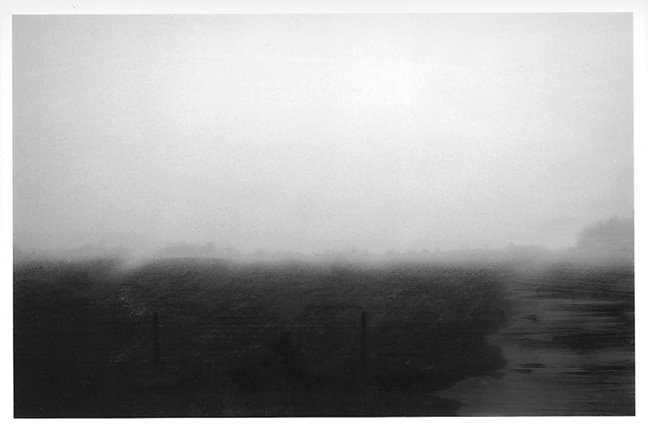
Red House Painters, in their song 'Have You Forgotten' describes with compelling accuracy what childhood in the late Eighties was like. Between the ages of 2 and 9 were a time, for me, of long hair on boys and short shorts with high socks, new records on those special Fridays, and the Pontiac Boneville wagon with wood-grain on the side. It's difficult to put my memories of my parents then in tune with what my parents are like today, but I'd like to think that it was a melancholy time for them too--melancholy as in the way the upstairs was dead still on summer afternoons on the weekends, with that light shining in on the pale yellows, the pale blues, the pale pinks, and my sister's bulging bangs and our children's books. Everybody has photographs of these moments that none would deny their melancholy tone. Christmas pictures with browns and deep greens, bright reds, and earth-toned clothing. Summer pictures with a thin layer of sweat on the brow, newer tract housing in the background, and tables set with glasses stamped with yellow, red, and green things on the outside.
I'd like to think that it was melancholy for my parents because I see some of my friends in the same position today that my parents were in at the time of these memories--the time of Red House Painters' 'Have You Forgotten.' ("when we were kids, we hated thing our sisters did"). It is the position of being young but realizing that you are getting older; of still being a dreamer of your life-to-be but realizing that what you face every morning when you get up in the cold bedroom is your life-to-be just as much as it is the moment; of longing to go it without the veneer, the anticipation of the regular, but knowing deep down that regularity is too often the best way to keep going at all. I imagine that my parents, particularly my mother, had a hard time facing these things with three kids surrounding them at all moments, each a year older or younger than his or her nearest sibling. I might even venture to say that my brother and sister and I would grasp and articulate a common solidarity of seeing our parents in this position in the late Eighties. We did not, of course, know it at the time, but children understand in ways that they just aren't able when they hit adolescense and never recover when they grow into adults (for the most part). We would know that it was a hard time for our parents, even though they loved us very clearly.
But trying to go without the veneer of a wife and kids, of the post-war way, of the exploding global world where credit cards and cable television were coming around, without the anticipation of normalcy--not knowing what five years would bring but then again knowing in that part of us that projects the melancholy of real life into the visions of life-to-be exactly what five years would bring; not being able to let go in the ways of days gone by but simultaeously clueless about what to do next, today, now, here, for these children and this spouse and this house and this person, this soul, this identity, this story, this being, this mind--all of it...is hard. I know it was hard on my mom and dad to work their lives out in that slowmotion sunny haze of the dusty Eighties for themselves, for each other, for their children, and for their vision and hopes for life-to-be.
And yet, I know that my parents were free-thinking enough to figure it out. I see some of my friends with children doing the same. And if I asked my parents today about those inchoate days from 1982-1991, I think they would grow somewhat sentimental for that time when everything seemed uncertain but at the same time fundamentally and essentially real. I think they talk about the subtle war they fought as individuals and as a couple and as a family to get a grounding on it all. But I think they would also say that they didn't realize this quiet melancholy war when it was being waged until after the fact. It is here, that they would find their younger idiosyncracies and free will, their confident rejection of the veneer, and not their not being embarrased about their lives as they were, to be the stuff of sweet recollection, humor, and fondness.
'Have You Forgotten' reminds me of those times when I sat upstairs in the pale yellow hallway late the afternoon of a summer Saturday reading 'A Child's Garden of Verses' with a sort of nappy drowsiness while my parents went about life downstairs waging their quiet, subtle war for the autonomous self, reconciling their stories, accepting the emerging, finding beauty in the present as a promise for rootedness in the future. Even these pursuits of war they might not be able to articulate today, but I remembered as a teenager to remember that I witnessed it when I was a child, 1986.
Chanson d'installation: Red House Painters, Have You Forgotten?
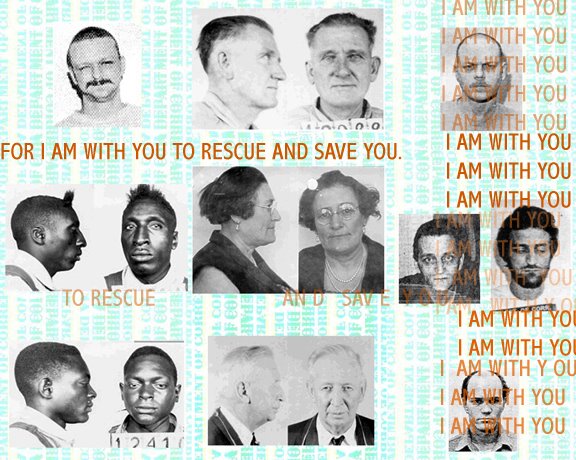
Tuesday, November 01, 2005
Tom DeLay Preevleezjay
A Whiny Motherfucker/Former Majority Leader
Tom DeLay just won't play if he can't have his way.
Citing "the media attention and noting that Austin [Texas], widely perceived as a liberal college town, is 'one of the last enclaves of the Democratic Party in Texas,'" DeLay's CronySquad bitched about having his trial for the betrayal of public trust and corruption in the capital city of his home state. Are we supposed to presume that DeLay is an umblemmished figure of public service when he himself cannot presume the same for those to whose authority he is now suddenly subject? Am I supposed to believe his suavingly rad claims of innocence when he his suspcious of his own elected public official? Am I supposed to ignore the convictions against DeLay vis-a-vis his own long-standing (and accussed, mind you) favortism, cronyism, and widespread donation-doling? This is exactly why I don't trust DeLay to begin with. He uses his power to get what he wants, when he wants it, and how he wants it, and wields his wealth and power to duck out on accountability--courts of law, Congressional inquiry, etc.--for his actions when he is called to do so. Now you know what it's like bitch. Oh wait, no you don't because you're a True Texas Corrupto Man.
In terms of DeLay's [now former] judge, the District Attorney hit it right on the nose: "The law expresses no need for judges to check the citizenship at the courtroom door," she said. As much as DeLay and the Republican Machine advocate Americans checking in their citizenship at the door, it's no wonder DeLay thought that his own elected official (read: chosen by the will of the people) found it threatening that his new keeper was a indeed a citizen, chosen by the will of the people to hold him accountable. I'd like to see an impoverished black man accused of a crime manage to get a trial relocation or change of judge. Won't happen--especially not in Texas.
My next post will convict the the rightest obliviates of their failure to think critically in regard to the Supreme Court. Then I'm taking a break from cynical political commentary. No more calling people motherfuckers, unless they're really, truly MFers.
Chanson d'installation: Eminem, Mosh
Tom DeLay just won't play if he can't have his way.
Citing "the media attention and noting that Austin [Texas], widely perceived as a liberal college town, is 'one of the last enclaves of the Democratic Party in Texas,'" DeLay's CronySquad bitched about having his trial for the betrayal of public trust and corruption in the capital city of his home state. Are we supposed to presume that DeLay is an umblemmished figure of public service when he himself cannot presume the same for those to whose authority he is now suddenly subject? Am I supposed to believe his suavingly rad claims of innocence when he his suspcious of his own elected public official? Am I supposed to ignore the convictions against DeLay vis-a-vis his own long-standing (and accussed, mind you) favortism, cronyism, and widespread donation-doling? This is exactly why I don't trust DeLay to begin with. He uses his power to get what he wants, when he wants it, and how he wants it, and wields his wealth and power to duck out on accountability--courts of law, Congressional inquiry, etc.--for his actions when he is called to do so. Now you know what it's like bitch. Oh wait, no you don't because you're a True Texas Corrupto Man.
In terms of DeLay's [now former] judge, the District Attorney hit it right on the nose: "The law expresses no need for judges to check the citizenship at the courtroom door," she said. As much as DeLay and the Republican Machine advocate Americans checking in their citizenship at the door, it's no wonder DeLay thought that his own elected official (read: chosen by the will of the people) found it threatening that his new keeper was a indeed a citizen, chosen by the will of the people to hold him accountable. I'd like to see an impoverished black man accused of a crime manage to get a trial relocation or change of judge. Won't happen--especially not in Texas.
My next post will convict the the rightest obliviates of their failure to think critically in regard to the Supreme Court. Then I'm taking a break from cynical political commentary. No more calling people motherfuckers, unless they're really, truly MFers.
Chanson d'installation: Eminem, Mosh
Tuesday, October 25, 2005
One for every year since Christ
Roll Call of the Death Toll
The New York Times has published the feature at the link below to commemorate the 2000th senseless casualty of America's war against shadows. Take a good look at the pictures. They're posted for a reason. Notice where the Michigan dead lived, and then try to deny that poor Americans are the capital of our country's belligerant foreign policy games. To all you thick-headed advocates of the Bush machine's war-mongering, your testosteronic and painfully ignorant pride is less valuable than the two-thousand recorded American casualties seen here. Putting a Dick Cheney 'baseball card' on your door at Dutch House and making snide, dumb-ass Hillary Clinton jokes won't give your pride more value either.
http://www.nytimes.com/2005/10/26/national/IRAQDEATHS_GRAPHIC.html
Chanson d'installation: still Danny Boy
The New York Times has published the feature at the link below to commemorate the 2000th senseless casualty of America's war against shadows. Take a good look at the pictures. They're posted for a reason. Notice where the Michigan dead lived, and then try to deny that poor Americans are the capital of our country's belligerant foreign policy games. To all you thick-headed advocates of the Bush machine's war-mongering, your testosteronic and painfully ignorant pride is less valuable than the two-thousand recorded American casualties seen here. Putting a Dick Cheney 'baseball card' on your door at Dutch House and making snide, dumb-ass Hillary Clinton jokes won't give your pride more value either.
http://www.nytimes.com/2005/10/26/national/IRAQDEATHS_GRAPHIC.html
Chanson d'installation: still Danny Boy
Conversation
Pipe Dreams
Here are selected portions of a conversation Dawn and I recently had online.
Leidio: yeah dude...that's the epicenter of the east village.
Leidio: tompkins square park is where all the shit goes down.
Leidio: and stuyvessant town is down there--infamous projects.
Leidio: i fuckin' hate new york.
Leidio: it's so miserable to live in.
SaturnLeia: yeah, I know
Leidio: people there are in systemmatic denial
Leidio: how's ryan liking it?
SaturnLeia: I don't think I could move there, even though I love it
Leidio: the city you visit is not the city you call home.
SaturnLeia: she likes it, but then she wasn't under any delusions when she moved there--she knew it wasn't going to be all roses
SaturnLeia: it can be really isolating
Leidio: it changes face in stark contrast.
SaturnLeia: yeah
SaturnLeia: well, I think it'd be cool to live there, but it would be even harder to do music
SaturnLeia: totally oversaturated, and the audiences are ADD
SaturnLeia: much better to tour through and visit
Leidio: why would it be cool to live there
Leidio: ?
SaturnLeia: there are certain areas I really like, and the city has a lot of energy
Leidio: so do most cities.
SaturnLeia: for example, Clinton Hill or the Eurpean-ish area I mentioned
SaturnLeia: I know
Leidio: you should visit boston...talk about european-ish.
Leidio: but you're expressing a major perturbance of mine (nothing personal)....
Leidio: and that is
SaturnLeia: there's so much art going on, and a lot of places to do the kinds of things I'm interested in even in ministry, in terms of bringing art and faith together
SaturnLeia: I really want to visit Boston
Leidio: the inability of americans to understand and appreciate the american city. we're don't have european urbanism nor do we fuckin' want it.
SaturnLeia: I think I'll move to Chicago though, although it doesn't look like the greatest place to work on music either
SaturnLeia: I appreciate the American city
Leidio: but i thought art occurs everywhere. you know, the shakers merged art, worldview, lifestyle, and faith without new york.
SaturnLeia: I didn't like that area because it was European, I liked it and it reminded me of Europe
SaturnLeia: two different things
SaturnLeia: definitely
SaturnLeia: it's just a critical mass--or in New York's case, an oversaturation
Leidio: sure, but the same desire...the same totem, the same pipe dream, mirage, daydream, the same phenomenological desire.
SaturnLeia: really if I was putting music above all other considerations, I'd move somewhere on the East Coast, by upstate New York
SaturnLeia: it's the best place to be in terms of being able to tour easily to lots of places
Leidio: now you're talkin.
SaturnLeia: but I do want to go a big city, at least for a while
SaturnLeia: though I think one of the reasons I like Evanston is that it's kind of like Ann Arbor, but it's by Chicago
Leidio: art comes out of place. new york has turned its back on place, instead asserting place as its received discombobulation.
SaturnLeia: yeah, too many people there are obsessed with seeming avant garde
SaturnLeia: Ryan and I talked a lot about that too
Leidio: I will presume to bet that you like (and that I like) Evanston because it's definition of place is the 'critical mass' of urbanism at a human scale that coexists with an identity of landscape as well as a clear structure for social and communal interaction.
Leidio: all of these things New York lacks.
SaturnLeia: she loves to do video dance, and did before finding out that it was the "in" thing to do--but now you get so many people doing multimedia with dance that it's become something that people throw in--the video, I mean--just because rather than because they're trying to really use it to make a statement of significance
SaturnLeia: yeah
SaturnLeia: I think my ideal is a managable mid-sized city bordering a large one
Leidio: they're obsessed with the avant-garde because they have no worldviews. because they go to new york to deny their boring upbringings and expectations, but realize that they have no substance to actual deny. the whole thing is angst--it's a contrived pipe dream in which there is no other recourse but to repeat the thing that lacks definition (the avant-garde) because there's nothing actually definitive to rail against.
SaturnLeia: ah, but they aren't even railling against anything usually even in theory--it's just that video dance is cool and new, so everyone's flocking to it
Leidio: you said it: cambridge, ann arbor, evanston, east lansing, annapolis...
SaturnLeia: as Ryan put it, "If I see one more piece with TV static I think I'm going to scream"
Leidio: but that's my point...they have nothing to rail against because their lives have no substance. so they just repeat the thing that lacks definition (the avant-garde)
SaturnLeia: yeah, unfortunately Ann Arbor and East Lansing aren't bordering the cities I find interesting in terms of what's going on
SaturnLeia: as much as I love Detroit
SaturnLeia: it's on the up, but it's not quite the place I want to be -- that and I need to get out of the state
Leidio: dude, Lansing is a freaking' mine waiting to be opened.
SaturnLeia: heh
Leidio: it will just take people that aren't air-heady artsy types to do it.
Leidio: it will take critical criticism, a standpoint on culture, a goal that isn't an art-world free-for-all.
SaturnLeia: do you really think Lansing can go anywhere interesting?
SaturnLeia: it seems like in state the place that's going to happen is Detroit
SaturnLeia: but it'll need a lot of intrastructure and perserverance
Leidio: but dawn, maybe it's the kind of place you should be. if not you, who? that's just the trouble...everybody wants to live the pipe dream.
Leidio: Lansing has already been a successful city in its history.
SaturnLeia: I feel like I'm already living a pipe dream--I may end up getting a full-time job so I can support the music
Leidio: it's beed a lack of infrastructure, actually. rip up the freeways. detroit thrived before freeways existed. they will be dinosaurs in the next 30 years anyway.
SaturnLeia: no kidding
Leidio: you're already living the pipe dream?
Leidio: how?
SaturnLeia: heh, the starving artist thing is always a pipe dream
SaturnLeia: trying to make a living at performing
SaturnLeia: it's a different one than rebuilding a city
SaturnLeia: can't live too many pipe dreams at once
SaturnLeia: one is already definitionally unstable
Leidio: but it's only recently a pipe dream. the history of the 'starving artist' is one contrived in after the war and recast into the years preceding it.
SaturnLeia: how so?
SaturnLeia: I don't know that the arts have ever been particularly stable
Leidio: it's not a different task...rebuilding cities takes people making a living doing what they do.
SaturnLeia: yes, but if you're not making a living...
Leidio: au contraire the arts have been mostly stable throughout history.
SaturnLeia: I don't know though, one of the ways that a few cities have been revitalized is artists moving in
SaturnLeia: so many it's not so crazy, it's just not something I feel passionate about
Leidio: then you can branch out, and fulfill another need in the city...like a place for other performers, a place for a pragmatic need, like bread and sewing thread, a place to buy coats and umbrellas, nuts, toys, etc.
SaturnLeia: I feel like in the last 50 years or so there's definitely become a larger gap in terms of money--the little indie people at the bottom barely eeek out a living while the people at the top just rake it in
Leidio: artists moving in has only signified that change is possible. really, they're guinea pigs for developers.
SaturnLeia: lol
Leidio: hello dawn...that's what the entire world is becoming.
Leidio: let me tell you this...
SaturnLeia: I know, it's the story of everything these days
SaturnLeia: rich richer, poor poorer, and it's probably not going to change for the better
Leidio: Albert Bierstadt, the famous and important 19th-century American landscape painter, used to sell his paintings while starting out my ficitonalizing the place-names of his pieces to provoke a sense of ownership in his buyers of the still-mythic American frontier.
Leidio: What he did so well was to make his art relevant to the disposition of cultural stories--and myths--at large. but he didn't cater to them, nor did he create them. he simply reiterated their content. his paintings did this as well.
SaturnLeia: hmm, so are we looking for people to do this now in other media?
Leidio: in all things. our 'work' should emergently reiterate our story as a culture.
SaturnLeia: I think one of the cool things about Sujian Stevens is that he is creating art specific to places, but it still has broad appeal
SaturnLeia: it's the opposite of the pop music that is so general as to become irrelevant
SaturnLeia: but you could argue that our work automatically reiterates our story, and the proliferation of the pop crap--in many disciplines--also says something, perhaps that we want amnesia
Leidio: right! sufjan is at the vanguard, and he's not an avant-gardist nor an esoteric. he's at the vanguard while creating according to grounding asepct of life that we have otherwise denied and forgotten at large...landscape, memory, history, place, ethics, identity, knowing, heritage.
Leidio: but is amnesia what we really ought to value?
Leidio: i think we both know--no.
SaturnLeia: we shouldn't value it, but as a culture we're celebrating it
SaturnLeia: I'm kind of inspired by what he's doing
Chanson d'Installation: Danny Boy
Here are selected portions of a conversation Dawn and I recently had online.
Leidio: yeah dude...that's the epicenter of the east village.
Leidio: tompkins square park is where all the shit goes down.
Leidio: and stuyvessant town is down there--infamous projects.
Leidio: i fuckin' hate new york.
Leidio: it's so miserable to live in.
SaturnLeia: yeah, I know
Leidio: people there are in systemmatic denial
Leidio: how's ryan liking it?
SaturnLeia: I don't think I could move there, even though I love it
Leidio: the city you visit is not the city you call home.
SaturnLeia: she likes it, but then she wasn't under any delusions when she moved there--she knew it wasn't going to be all roses
SaturnLeia: it can be really isolating
Leidio: it changes face in stark contrast.
SaturnLeia: yeah
SaturnLeia: well, I think it'd be cool to live there, but it would be even harder to do music
SaturnLeia: totally oversaturated, and the audiences are ADD
SaturnLeia: much better to tour through and visit
Leidio: why would it be cool to live there
Leidio: ?
SaturnLeia: there are certain areas I really like, and the city has a lot of energy
Leidio: so do most cities.
SaturnLeia: for example, Clinton Hill or the Eurpean-ish area I mentioned
SaturnLeia: I know
Leidio: you should visit boston...talk about european-ish.
Leidio: but you're expressing a major perturbance of mine (nothing personal)....
Leidio: and that is
SaturnLeia: there's so much art going on, and a lot of places to do the kinds of things I'm interested in even in ministry, in terms of bringing art and faith together
SaturnLeia: I really want to visit Boston
Leidio: the inability of americans to understand and appreciate the american city. we're don't have european urbanism nor do we fuckin' want it.
SaturnLeia: I think I'll move to Chicago though, although it doesn't look like the greatest place to work on music either
SaturnLeia: I appreciate the American city
Leidio: but i thought art occurs everywhere. you know, the shakers merged art, worldview, lifestyle, and faith without new york.
SaturnLeia: I didn't like that area because it was European, I liked it and it reminded me of Europe
SaturnLeia: two different things
SaturnLeia: definitely
SaturnLeia: it's just a critical mass--or in New York's case, an oversaturation
Leidio: sure, but the same desire...the same totem, the same pipe dream, mirage, daydream, the same phenomenological desire.
SaturnLeia: really if I was putting music above all other considerations, I'd move somewhere on the East Coast, by upstate New York
SaturnLeia: it's the best place to be in terms of being able to tour easily to lots of places
Leidio: now you're talkin.
SaturnLeia: but I do want to go a big city, at least for a while
SaturnLeia: though I think one of the reasons I like Evanston is that it's kind of like Ann Arbor, but it's by Chicago
Leidio: art comes out of place. new york has turned its back on place, instead asserting place as its received discombobulation.
SaturnLeia: yeah, too many people there are obsessed with seeming avant garde
SaturnLeia: Ryan and I talked a lot about that too
Leidio: I will presume to bet that you like (and that I like) Evanston because it's definition of place is the 'critical mass' of urbanism at a human scale that coexists with an identity of landscape as well as a clear structure for social and communal interaction.
Leidio: all of these things New York lacks.
SaturnLeia: she loves to do video dance, and did before finding out that it was the "in" thing to do--but now you get so many people doing multimedia with dance that it's become something that people throw in--the video, I mean--just because rather than because they're trying to really use it to make a statement of significance
SaturnLeia: yeah
SaturnLeia: I think my ideal is a managable mid-sized city bordering a large one
Leidio: they're obsessed with the avant-garde because they have no worldviews. because they go to new york to deny their boring upbringings and expectations, but realize that they have no substance to actual deny. the whole thing is angst--it's a contrived pipe dream in which there is no other recourse but to repeat the thing that lacks definition (the avant-garde) because there's nothing actually definitive to rail against.
SaturnLeia: ah, but they aren't even railling against anything usually even in theory--it's just that video dance is cool and new, so everyone's flocking to it
Leidio: you said it: cambridge, ann arbor, evanston, east lansing, annapolis...
SaturnLeia: as Ryan put it, "If I see one more piece with TV static I think I'm going to scream"
Leidio: but that's my point...they have nothing to rail against because their lives have no substance. so they just repeat the thing that lacks definition (the avant-garde)
SaturnLeia: yeah, unfortunately Ann Arbor and East Lansing aren't bordering the cities I find interesting in terms of what's going on
SaturnLeia: as much as I love Detroit
SaturnLeia: it's on the up, but it's not quite the place I want to be -- that and I need to get out of the state
Leidio: dude, Lansing is a freaking' mine waiting to be opened.
SaturnLeia: heh
Leidio: it will just take people that aren't air-heady artsy types to do it.
Leidio: it will take critical criticism, a standpoint on culture, a goal that isn't an art-world free-for-all.
SaturnLeia: do you really think Lansing can go anywhere interesting?
SaturnLeia: it seems like in state the place that's going to happen is Detroit
SaturnLeia: but it'll need a lot of intrastructure and perserverance
Leidio: but dawn, maybe it's the kind of place you should be. if not you, who? that's just the trouble...everybody wants to live the pipe dream.
Leidio: Lansing has already been a successful city in its history.
SaturnLeia: I feel like I'm already living a pipe dream--I may end up getting a full-time job so I can support the music
Leidio: it's beed a lack of infrastructure, actually. rip up the freeways. detroit thrived before freeways existed. they will be dinosaurs in the next 30 years anyway.
SaturnLeia: no kidding
Leidio: you're already living the pipe dream?
Leidio: how?
SaturnLeia: heh, the starving artist thing is always a pipe dream
SaturnLeia: trying to make a living at performing
SaturnLeia: it's a different one than rebuilding a city
SaturnLeia: can't live too many pipe dreams at once
SaturnLeia: one is already definitionally unstable
Leidio: but it's only recently a pipe dream. the history of the 'starving artist' is one contrived in after the war and recast into the years preceding it.
SaturnLeia: how so?
SaturnLeia: I don't know that the arts have ever been particularly stable
Leidio: it's not a different task...rebuilding cities takes people making a living doing what they do.
SaturnLeia: yes, but if you're not making a living...
Leidio: au contraire the arts have been mostly stable throughout history.
SaturnLeia: I don't know though, one of the ways that a few cities have been revitalized is artists moving in
SaturnLeia: so many it's not so crazy, it's just not something I feel passionate about
Leidio: then you can branch out, and fulfill another need in the city...like a place for other performers, a place for a pragmatic need, like bread and sewing thread, a place to buy coats and umbrellas, nuts, toys, etc.
SaturnLeia: I feel like in the last 50 years or so there's definitely become a larger gap in terms of money--the little indie people at the bottom barely eeek out a living while the people at the top just rake it in
Leidio: artists moving in has only signified that change is possible. really, they're guinea pigs for developers.
SaturnLeia: lol
Leidio: hello dawn...that's what the entire world is becoming.
Leidio: let me tell you this...
SaturnLeia: I know, it's the story of everything these days
SaturnLeia: rich richer, poor poorer, and it's probably not going to change for the better
Leidio: Albert Bierstadt, the famous and important 19th-century American landscape painter, used to sell his paintings while starting out my ficitonalizing the place-names of his pieces to provoke a sense of ownership in his buyers of the still-mythic American frontier.
Leidio: What he did so well was to make his art relevant to the disposition of cultural stories--and myths--at large. but he didn't cater to them, nor did he create them. he simply reiterated their content. his paintings did this as well.
SaturnLeia: hmm, so are we looking for people to do this now in other media?
Leidio: in all things. our 'work' should emergently reiterate our story as a culture.
SaturnLeia: I think one of the cool things about Sujian Stevens is that he is creating art specific to places, but it still has broad appeal
SaturnLeia: it's the opposite of the pop music that is so general as to become irrelevant
SaturnLeia: but you could argue that our work automatically reiterates our story, and the proliferation of the pop crap--in many disciplines--also says something, perhaps that we want amnesia
Leidio: right! sufjan is at the vanguard, and he's not an avant-gardist nor an esoteric. he's at the vanguard while creating according to grounding asepct of life that we have otherwise denied and forgotten at large...landscape, memory, history, place, ethics, identity, knowing, heritage.
Leidio: but is amnesia what we really ought to value?
Leidio: i think we both know--no.
SaturnLeia: we shouldn't value it, but as a culture we're celebrating it
SaturnLeia: I'm kind of inspired by what he's doing
Chanson d'Installation: Danny Boy
Wednesday, October 19, 2005
A Very Weird Sort of Pedantics
Right on cue, the architectural establishment gets prissy
"I don't think the answer is to bring somebody in with a canned response," says Eric Owen Moss, director of the Southern California Institute of Architecture. "There are fundamental issues of how to deal with that coastline, how to build, if you build at all."
He reads disturbing cultural messages in the quaint enclaves of New Urbanism. "It's right-wing developer-speak masquerading as populism," Moss says. "The ideological image-making would appeal to a kind of anachronistic Mississippi that yearns for the good old days of the Old South as slow and balanced and pleasing and breezy, and each person knew his or her role."
-from the Washington Post
Eric Owen Moss, a poster boy for "progressive" architecture and a member of the global businness-academy complex, has criticized The Mississippi Renewal Forum, a proactive and sensate group of planners, architects, policy gurus, elected fficials, and urbanists that has gathered together to develop a reasonable and productive vision on what rebuilidng the Gulf Coast will entail, how it might be effected, and what it might contain, saying that the solutions of so many presumed "New Urbanists" will be prissy and syrupy. Let me just say that I don't see Eric Owen Moss taking up shop amidst the ruins of the Gulf Coast (the MRF did their work in a damaged casino-hotel, where they all gathered for what is called a 'charrette'--a kind of projective vision-casting series of all-nighters that channel adrenaline and ideas into a very dense exchange and articulation of solutions) working out a reconstruction scheme that addresses not only architecture but poverty, environmental constraints, preservation, socio-economic stratification, political strategy, transportatioan, infrastructure, public works, housing, civic functions, public space, economies, markets, public policy, the consequences of suburbanization, and so many other pragmatic but pervasive considerations of place, not to mention the most relevant concepts such as heritage, accessibility, recognition, collective space, memory, security, and sustainability. Eric Owen Moss typifies the state of the architectural community today and I'm barely capable to articulating what that state is with appropriate representation. People like Moss--found in every single damned nook and cranny in the architectural community--believe that the only possible solution with situations like the Gulf Coast is to come up with something 'new' and "progressive."
But let me tell you folks, the concept of "new" at play in the architectural community is one rooted in the ambition for ego-driven prestige, for academic admiration, for professional praise, for artistic esotericism, for conceptual obfiscuity, for aesthetic shock, for widespread and comprehensive social, economic, and political commentary distilled into a set of objectives that are small enough to slap on the face of a presentation board (lest the critics criticize for an "unclear presentation" with "inchoate terminology"). Fuckers like Eric Owen Moss are out for themselves. They pass the days with nihilistic dreams of stardome, fanfare, authority, admiration, pure and unrequitted genius, and come up with a meaningless but complicated vocabulary with which to assert and achieve it. But the sentiments and the ideas of people like Eric Owen Moss are vacuous and shallow. They are very nearly purely contrived, and carry no relevance or import to the average citizen who lost her home of 150 years in Hurricane Katrina. For her, whatever sort of schizophrenic Deleuzian nihilistic basless placeless shrapnel-shard jagged dizzying slice of death architecture that Eric Owen Moss has to replace her home and neighborhood (and I presume he has something to propose if he sits in freaking Los Angeles--go fuckin' figure--criticizing the only people to actually attempt a meaningful service to the disenfranchised hundreds of thousands of the Gulf Coast with snide and condescending rhetorical shenanigans) just ain't going to slice the bacon. What the architectural community has to serve is thin gruel if you're hungry. Just take a look for yourself: which of the following examples do you think are the most relevant to the place of the Gulf Coast?


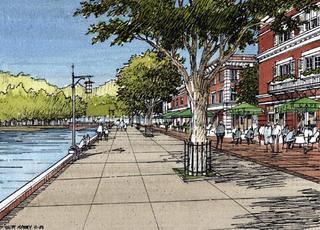


Chanson d'installation: Common, A Film Called Pimp
"I don't think the answer is to bring somebody in with a canned response," says Eric Owen Moss, director of the Southern California Institute of Architecture. "There are fundamental issues of how to deal with that coastline, how to build, if you build at all."
He reads disturbing cultural messages in the quaint enclaves of New Urbanism. "It's right-wing developer-speak masquerading as populism," Moss says. "The ideological image-making would appeal to a kind of anachronistic Mississippi that yearns for the good old days of the Old South as slow and balanced and pleasing and breezy, and each person knew his or her role."
-from the Washington Post
Eric Owen Moss, a poster boy for "progressive" architecture and a member of the global businness-academy complex, has criticized The Mississippi Renewal Forum, a proactive and sensate group of planners, architects, policy gurus, elected fficials, and urbanists that has gathered together to develop a reasonable and productive vision on what rebuilidng the Gulf Coast will entail, how it might be effected, and what it might contain, saying that the solutions of so many presumed "New Urbanists" will be prissy and syrupy. Let me just say that I don't see Eric Owen Moss taking up shop amidst the ruins of the Gulf Coast (the MRF did their work in a damaged casino-hotel, where they all gathered for what is called a 'charrette'--a kind of projective vision-casting series of all-nighters that channel adrenaline and ideas into a very dense exchange and articulation of solutions) working out a reconstruction scheme that addresses not only architecture but poverty, environmental constraints, preservation, socio-economic stratification, political strategy, transportatioan, infrastructure, public works, housing, civic functions, public space, economies, markets, public policy, the consequences of suburbanization, and so many other pragmatic but pervasive considerations of place, not to mention the most relevant concepts such as heritage, accessibility, recognition, collective space, memory, security, and sustainability. Eric Owen Moss typifies the state of the architectural community today and I'm barely capable to articulating what that state is with appropriate representation. People like Moss--found in every single damned nook and cranny in the architectural community--believe that the only possible solution with situations like the Gulf Coast is to come up with something 'new' and "progressive."
But let me tell you folks, the concept of "new" at play in the architectural community is one rooted in the ambition for ego-driven prestige, for academic admiration, for professional praise, for artistic esotericism, for conceptual obfiscuity, for aesthetic shock, for widespread and comprehensive social, economic, and political commentary distilled into a set of objectives that are small enough to slap on the face of a presentation board (lest the critics criticize for an "unclear presentation" with "inchoate terminology"). Fuckers like Eric Owen Moss are out for themselves. They pass the days with nihilistic dreams of stardome, fanfare, authority, admiration, pure and unrequitted genius, and come up with a meaningless but complicated vocabulary with which to assert and achieve it. But the sentiments and the ideas of people like Eric Owen Moss are vacuous and shallow. They are very nearly purely contrived, and carry no relevance or import to the average citizen who lost her home of 150 years in Hurricane Katrina. For her, whatever sort of schizophrenic Deleuzian nihilistic basless placeless shrapnel-shard jagged dizzying slice of death architecture that Eric Owen Moss has to replace her home and neighborhood (and I presume he has something to propose if he sits in freaking Los Angeles--go fuckin' figure--criticizing the only people to actually attempt a meaningful service to the disenfranchised hundreds of thousands of the Gulf Coast with snide and condescending rhetorical shenanigans) just ain't going to slice the bacon. What the architectural community has to serve is thin gruel if you're hungry. Just take a look for yourself: which of the following examples do you think are the most relevant to the place of the Gulf Coast?
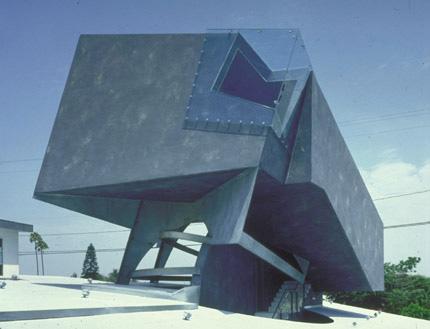

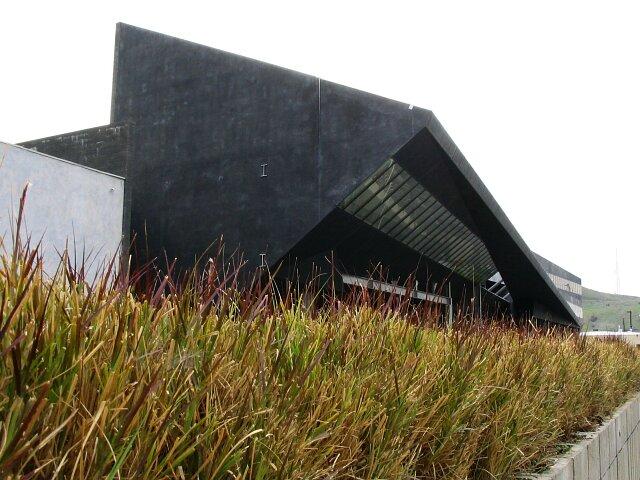
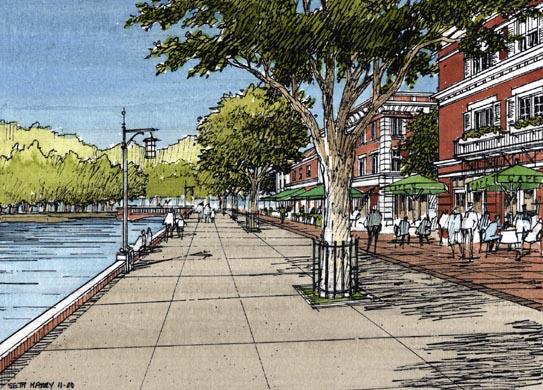


Chanson d'installation: Common, A Film Called Pimp
Sunday, October 16, 2005
Floodwaters
From the edge of the sea, a non-view
I bought a Moleskin sketchbook last week, but it's still blank. I can't think of anything in the course of my day worthwhile to put in it. I just finished three weeks of searching for a hidden room but didn't find it, claiming it was "lost in the gradient" though the gradient was not drawn either. Waiting for a table for twenty minutes at least at Peet's today, I tried to read people to see if they would leave, creating fiction to pass the din and time, though too often my fictions were tall tales. The bored were the eager and the silent the occupied. It rained for a week along the northeast, and floodwaters came upon us, from Framingham to Storrow. A night along Atlantic Avenue where taxi cabs and commuters floated by the Federal Reserve made me think of that city in my mind that I've glimpsed every here and there for a good number of years now. I met my parents for tea at the Four Seasons and looked out the window at Boston Common while the rain persisted, while the leaves persisted in a hushed vernal lush as the sun set behind an endless gauze of clouds. Some might say a sarcophagus. I think the clouds make for hermitage. In hermitage, water seeping into and out of the ground is at the scale of fingers and toes, shoelaces and the points of umbrellas; points of leaves and pin-hole photographs. A hard wind came this morning and with it the sun, and then died off when it blowed itself over into the Atlantic. The city dried, and I put on another layer of wool. I munched on crusty bread at the last of the latter's face-shone light, and walked through the square where tourists and flakes cringed toward the wind. Then went home, and turned on the lights. Shed wool for a Classics hood, and sat down at the table to read.
Chanson d'installation: Arvo Part, Cantus in Memoriam Benjamin Britten
I bought a Moleskin sketchbook last week, but it's still blank. I can't think of anything in the course of my day worthwhile to put in it. I just finished three weeks of searching for a hidden room but didn't find it, claiming it was "lost in the gradient" though the gradient was not drawn either. Waiting for a table for twenty minutes at least at Peet's today, I tried to read people to see if they would leave, creating fiction to pass the din and time, though too often my fictions were tall tales. The bored were the eager and the silent the occupied. It rained for a week along the northeast, and floodwaters came upon us, from Framingham to Storrow. A night along Atlantic Avenue where taxi cabs and commuters floated by the Federal Reserve made me think of that city in my mind that I've glimpsed every here and there for a good number of years now. I met my parents for tea at the Four Seasons and looked out the window at Boston Common while the rain persisted, while the leaves persisted in a hushed vernal lush as the sun set behind an endless gauze of clouds. Some might say a sarcophagus. I think the clouds make for hermitage. In hermitage, water seeping into and out of the ground is at the scale of fingers and toes, shoelaces and the points of umbrellas; points of leaves and pin-hole photographs. A hard wind came this morning and with it the sun, and then died off when it blowed itself over into the Atlantic. The city dried, and I put on another layer of wool. I munched on crusty bread at the last of the latter's face-shone light, and walked through the square where tourists and flakes cringed toward the wind. Then went home, and turned on the lights. Shed wool for a Classics hood, and sat down at the table to read.
Chanson d'installation: Arvo Part, Cantus in Memoriam Benjamin Britten
Thursday, October 06, 2005
Evildoers to Create Empire of Slavery from Spain to Indonesia
Speaking of pathological...

So says G-Dubs on October 6 at the National Endowment for Democracy:
"The militants believe that controlling one country
will rally the Muslim masses, enabling them to
overthrow all moderate governments in the region and
establish a radical Islamic empire that expands from
Spain to Indonesia."
and that their goal is to:
"enslave whole nations and intimidate the world."
This is what we call paranoia. He goes on:
"We will never back down, never give in and never
accept anything less than complete victory,"
This is what we call nihilism. Later, in the same speech, Bush says:
"Bin Laden says his own role is to tell Muslims:
'What is good for them and what is not.' And what
this man who grew up in wealth and privilege considers
good for poor Muslims is that they become killers and
suicide bombers. He assures them that this is the
road to paradise, though he never offers to go along
for the ride,"
What's funny is that this statement could easily characterize Bush himself:
"Bush says his own role is to tell Americans: 'What is
good for them and what is not.' And what this man who
grew up in wealth and privilege considers good for poor
Americans is that they become soldiers and war heroes.
He assures them that this is the road to honor and
freedom, though he never offers to go along for the ride."
Fuck you Dubs.
Chanson d'installation: French Kicks, Trial of the Century

So says G-Dubs on October 6 at the National Endowment for Democracy:
"The militants believe that controlling one country
will rally the Muslim masses, enabling them to
overthrow all moderate governments in the region and
establish a radical Islamic empire that expands from
Spain to Indonesia."
and that their goal is to:
"enslave whole nations and intimidate the world."
This is what we call paranoia. He goes on:
"We will never back down, never give in and never
accept anything less than complete victory,"
This is what we call nihilism. Later, in the same speech, Bush says:
"Bin Laden says his own role is to tell Muslims:
'What is good for them and what is not.' And what
this man who grew up in wealth and privilege considers
good for poor Muslims is that they become killers and
suicide bombers. He assures them that this is the
road to paradise, though he never offers to go along
for the ride,"
What's funny is that this statement could easily characterize Bush himself:
"Bush says his own role is to tell Americans: 'What is
good for them and what is not.' And what this man who
grew up in wealth and privilege considers good for poor
Americans is that they become soldiers and war heroes.
He assures them that this is the road to honor and
freedom, though he never offers to go along for the ride."
Fuck you Dubs.
Chanson d'installation: French Kicks, Trial of the Century
Tuesday, October 04, 2005
A Dose of the 'Dozer
Pathological self-exposure
Check out these quotations from the pathological clowns of the Republican complex. Don't get so smug Democrats--you're mostly just sitting there in the orchestra pit while the show gets more and more absurd.
Now See Here!
Chanson d'installation: Something Ornette Coleman
Check out these quotations from the pathological clowns of the Republican complex. Don't get so smug Democrats--you're mostly just sitting there in the orchestra pit while the show gets more and more absurd.
Now See Here!
Chanson d'installation: Something Ornette Coleman
Subscribe to:
Posts (Atom)