Premay 2007
I. Invocation
Dante:
during this so brief vigil of our senses
that is still reserved for us, do not deny
yourself experience of what there is beyond,
behind the sun, in the world they call unpeopled.
Canto XXVI
and
Rilke:
fear not suffering; the heaviness,
give it back to the weight of the earth;
the mountains are heavy, heavy the oceans.
even the trees you planted as children
long since grew too heavy, you could not sustain them.
ah, but the breezes; ah, but the spaces.
Sonnet to Orpheus IV
II. The Record
the shadowlands along summerstreets, oh, ann arbor.
these have been places of walks and peripatetices.
to lawns and porches of east ann street along 1010/210,
and the dutch house roof, the canopies out back;
the planada-rest in peace-and the corner of 7 where the Rhine spilled over;
catherine street:
where abided my boys loney and chap
on the petition couch,
squalor is high modernism lads—keep your heads up,
steadfast against all the misanthropics;
here stand the saturday morning sheds, zingerman's breadly,
and summer tables;
lawrence street and linford: you harbored me;
south fourth of three summer's past fans turning in lateday:
the west beckons across yard and leopold's where we have cleaned;
detroit street, washington, ashley on some sundays,
liberty out west and over the hill,
huron river to north territorial to m52;
cedar campus and whitefish point:
where we forged meta and in silent rooms traversed time
and rested lazy to begin again and striving to do so,
men's retreat and focus week of frozenbay broomball and narnia—
i left you a gnome and a thing called meta:
(tb douce, d dunkel, taitcha: onward for our burden is light)
blessed be these terrains and abodes.
to my people uprooted, dig in;
the fellows;
justin b (tinney some time yore);
dave o and dumie we formed a midhall triad;
eadie, mick, snuph, schteeny, sprech and carlsone the easy e;
delorean of car fame, meul, mccrack - see you all soon;
hubers of the south and the rest of it;
christie i may know you yet;
derek of cigars and carolina
and your honey ms. single no longer:
remember where you’ve been and why;
tom e thane of thanes much love to you and to the little ones;
troy and jess and as you have it boo and just last week samuel:
you are exemplars;
rich the aussie god bless you and the leelanau, the manistee—
i will see you in africa;
darren you're a legacy van der keesma;
hull i missed you; what happened since pre-moore talks on couches?;
muncey what can be said?--pass me a cigar;
chelsea in the leelenau from sf to jonestown keeps yer roots hun;
bling, ryan, dawn and/or delahoya: stratford was vernal even in the grey of autumn, blessings blessings blessings;
keith at asp, john perkins down in jackson;
ann s of mo and la keep breathing;
whang of jersey like fish in and out of water please be strong,
and this premay a new line to you:
look now upon yourself—you have been given sight;
k v dyke and The Pressing;
raynor post focus week i miss the land that i never knew;
backypacky amy and rachel, we are all alone so let us hike;
the taubman crew: mississy, chang, lads with cigars and whiskey, alexa, hemingway, devereux and melissa, mick and bodley, ddrek;
ddrek of many nights at arbor our home;
graham, pennings, yang, melema, steveo, tb, tracy, ddault;
and the ivers: what has happened?;
what to you kg son of swan?: blessings—water has fallen;
alex, tait, andrew, megan, timmy: i love you;
muncey, meul, miked, daveo, easy e, and our clan: i love you too;
ra, ho, yang on oxford and grendel in the den: shalom.
to the new crew and to you lucius i missed you sooner;
to the emerging in the square: you have surprised me,
let us move headlong—
you have brought me peace here.
there is time for invocation but it is now befalling.
detroit, the havens, the dunes, the grasses, the tills, the orienters, the faded and resolute, the winds, the leaves, the frames, the colors, the treading grounds, the flats, the valley and the crag, the hollow and the gorge, the halls, manchester, chelsea, dexter, the fires at the farms, the deeps and the bales, rain on asphalt, the kin and the sages, and the restlessness of times which are imminent;
there is lore about thoroughly!
winter ebbs, there is much to be spoken.
Wednesday, April 18, 2007


Tuesday, March 20, 2007
Roundup
Who has a pencil? And some paper?

Recently I have been dumstruck, feeling the heavy weight of memory. Memory is a tricky thing. Here are some others: why the pressing urgency to go home that silenced me when surrounded by people; the plane that transited the 3 centimeter billions between l'unghia di dio and venus just at dusk to the southwest over the square; why is 6 miles above the earth at night a monastic, churning state in which i am reeling with voicelessness and the realization that i am, probably, a loser? Speech and memory cannot be separated. This is because the ontology of memory requires testament. I'm somewhat in to ontology. Speechlessness means that memory is free falling. What then will ground us? And we become losers.
I pulled Confessions from the bookcase tonight, knowing when I put it in a box to bring it to Cambridge that this time would come. Augustine and I would have this conversation:
me (P): bitterly cold, eh? never crisper. some moon, ya? do you know about the universe?
Augustine (A): the universe? yes, i know about it.
P: they know where it stops now, you know.
A: do they?
P: well, i imagine they do. what can i get you?
A: a fine, dark ale; round, blurred, but viscous.
P: well said. you have a knack for that, don't you?
A: it has been written.
P: let me ask you Augustine: was god in carthage?
A: you know, they know where the universe stops now.
P: except that all the same, there isn't just one anymore.
A: not just one? my teachers spoke of spheres...aethers.
P: right, right. spheres and aethers. and the...the...thing; the...
A: the fluid which drags the stars.
P: that's it.
A: no, god was in rome.
P: still is.
A: Monica used to say that.
P: yeah?
A: oh yes. what about the universe?
P: no, no. the universe, however many or one there is,
is not what i would like to know.
A: don't cry for me. the more you weep the less it's worth it.
P: wow. put in a fortune cookie.
A: the less you weep, the more you need to.
P: i can't speak.
A: you're a bastard.
P: no, seriously. i can't speak. there is no thread. one of your successors (well, a Berliner) made sophistries on feeling, thinking, knowing and doing. he was a lounge rat, and didn't have much to do on a day to day basis but you can see his concern.
A: ah, yes. i said to god let me recognize you as you have recognized me.
P: beware the freefall!
A: achtung! yes, you must find the ground.
P: i know where the ground is. i have fallen to it; it has consumed me.
A: be lofty, you are meant for free fall if you know the ground.
P: i am earth-bound; and i get nervous when in a plane.
A: speak, then.
P: i have tried this. i would rather drop hints again and again and again.
A: you're a sucker.
P: i would like to think not.
A: you must fall and rise to fall again. there are ends to things.
P: what things?
A: all things.
P: i can't speak!
A: you ought to seriously consider a remedy.
P: what about this recognition?
A: it's not enough. it was christ who descended in order that he should rise again. imagine if he had just shrugged and said, yeah, i get it. good game, guys.
P: do you have soccer?
A: in the academic sense. we call it hannibal's magic 8.
P: that's quirky. put it on a bar sign.
A: i will consider that. you should go speak now.
P: i will consider that. what binds all this to the pain in my gut?
A: it's up for grabs.
P: come on now. really? you don't mean that.
A: you are confusing scales.
P: yes, i'm prone to do that. but it's reasonable, right? isn't it a freefall?
A: no, it is an orbit.
P: no, it's quantum.
A: even quanta must be given shape. something must endow it with agency.
P: i would like to orbit. i would like to reach and grab on to something.
A: you already are orbiting. you have been recognized. but remember the scale of things. you are earthbound.
P: i know it. it is churning.
A: speak.

Recently I have been dumstruck, feeling the heavy weight of memory. Memory is a tricky thing. Here are some others: why the pressing urgency to go home that silenced me when surrounded by people; the plane that transited the 3 centimeter billions between l'unghia di dio and venus just at dusk to the southwest over the square; why is 6 miles above the earth at night a monastic, churning state in which i am reeling with voicelessness and the realization that i am, probably, a loser? Speech and memory cannot be separated. This is because the ontology of memory requires testament. I'm somewhat in to ontology. Speechlessness means that memory is free falling. What then will ground us? And we become losers.
I pulled Confessions from the bookcase tonight, knowing when I put it in a box to bring it to Cambridge that this time would come. Augustine and I would have this conversation:
me (P): bitterly cold, eh? never crisper. some moon, ya? do you know about the universe?
Augustine (A): the universe? yes, i know about it.
P: they know where it stops now, you know.
A: do they?
P: well, i imagine they do. what can i get you?
A: a fine, dark ale; round, blurred, but viscous.
P: well said. you have a knack for that, don't you?
A: it has been written.
P: let me ask you Augustine: was god in carthage?
A: you know, they know where the universe stops now.
P: except that all the same, there isn't just one anymore.
A: not just one? my teachers spoke of spheres...aethers.
P: right, right. spheres and aethers. and the...the...thing; the...
A: the fluid which drags the stars.
P: that's it.
A: no, god was in rome.
P: still is.
A: Monica used to say that.
P: yeah?
A: oh yes. what about the universe?
P: no, no. the universe, however many or one there is,
is not what i would like to know.
A: don't cry for me. the more you weep the less it's worth it.
P: wow. put in a fortune cookie.
A: the less you weep, the more you need to.
P: i can't speak.
A: you're a bastard.
P: no, seriously. i can't speak. there is no thread. one of your successors (well, a Berliner) made sophistries on feeling, thinking, knowing and doing. he was a lounge rat, and didn't have much to do on a day to day basis but you can see his concern.
A: ah, yes. i said to god let me recognize you as you have recognized me.
P: beware the freefall!
A: achtung! yes, you must find the ground.
P: i know where the ground is. i have fallen to it; it has consumed me.
A: be lofty, you are meant for free fall if you know the ground.
P: i am earth-bound; and i get nervous when in a plane.
A: speak, then.
P: i have tried this. i would rather drop hints again and again and again.
A: you're a sucker.
P: i would like to think not.
A: you must fall and rise to fall again. there are ends to things.
P: what things?
A: all things.
P: i can't speak!
A: you ought to seriously consider a remedy.
P: what about this recognition?
A: it's not enough. it was christ who descended in order that he should rise again. imagine if he had just shrugged and said, yeah, i get it. good game, guys.
P: do you have soccer?
A: in the academic sense. we call it hannibal's magic 8.
P: that's quirky. put it on a bar sign.
A: i will consider that. you should go speak now.
P: i will consider that. what binds all this to the pain in my gut?
A: it's up for grabs.
P: come on now. really? you don't mean that.
A: you are confusing scales.
P: yes, i'm prone to do that. but it's reasonable, right? isn't it a freefall?
A: no, it is an orbit.
P: no, it's quantum.
A: even quanta must be given shape. something must endow it with agency.
P: i would like to orbit. i would like to reach and grab on to something.
A: you already are orbiting. you have been recognized. but remember the scale of things. you are earthbound.
P: i know it. it is churning.
A: speak.
Sunday, January 21, 2007
Prophet
Hope for hope at the end of neo-liberalism
Cornel West writes that "our kids today see clearly the hypocrisies and mendacities of our society, and as they grow up they begin to question in a fundamental way some of the lies that they've received from society...This often leads to an ardent disappointment, and even anger, about the failures of our society to consistently uphold the democratic and humanitarian values tha can be born in youths in this phase of their life."
and continues:
"In the political sphere, the most significant expression today of this mix of anger, disappointment, and yet a tough-edged longing is the democratic globalization movement here and abroad."
What is a tough-edged longing, and who feels it today? The times today without a doubt bring me to anger and disappointment. I cannot comprehend the systematic idiocy of our country's economic nihilism. As a little-'d'-democrat my political values are rooted deeply in a simplicity that is rarely espoused in our country today, and always far away from the suburban wastelands and temporal industrial bilges along the fringes of cities that incubate the pseudo-, the pastiche, democratism of this free market age of disillusionment and despair. It infuriates me to hear our president speak. I want to give up when I see his crew placating the millions, patronizing the ideologically weakest and most vulnerable.
I've said it many times in the presence of collective despair that the prophet of Americanism is an extinct typology. I'm ultimately wrong about that. There are many people who I would consider prophetic. Wendell Berry, Daniel Schorr, even Sufjan Stevens, are all people in whom I recognize democratic prophesy. Many of our venerated figures of the past meet this characterization as well. Martin Luther King, Jr. was a prophetic; Harry Caudill was a prophetic; Rachel Carson was prophetic; Medgar Edgars was prophetic; Bobby Kennedy was prophetic. Were the Kennedy's shmucks? Probably, but they were lucrative enough to articulate some things that, despite their intentions in doing so, they saw as essential.
Bobby Kennedy. I have, in conversations about the upcoming presidential race, compared the potential of Barak Obama to the run of the younger Kennedy back in the 60s. Had he been elected--and he would have been elected--our country would be in a very different place right now. After Kennedy, the American project endured, and is enduring, a long onslaught of destructive, nihilistic, and undemocratic policy. We saw the quotidian, bottom-up concerns of everyday Americans in the American landscape, fighting against poverty and for an identity, disappear with the same acceleration in which free market capitalism came into veins of American democratism like a heroine, an illusory addiction, that made most hopes of an imperfect America that was worth the prophetic fight into no hope at all. The realization that many people and many structures were denying the prophetic from many Americans was the reason for the fight.
It is true that his country has never been perfect. People that believe that--they're called Republicans--are dumbass ignorant of basic historical inquiry. But the political means of democratism is self-reflection. It means that societies can procur systematic justice by affirming the increasingly discrete scales of justice that characterize the boundaries of human civlization. Thus the little-'d'-democrat turns to his neighbor, his family, himself, in self-reflection. This is a phenomenology of politics that hasn't been integral to an American vision since, I would argue, Jefferson, who had the opportunity to posit outcomes. Today, as in the era of Bobby Kennedy's run for office, we no longer have the luxury of starting from scratch. We must deal with the nihilism that has pervaded our economic will, cultural production, and incubated, uprooting, melancholy despair. It is the "tough-edged longing" that must be nursed. Otherwise, what does the American project have to live for? What is needed now, is a prophet. One who speaks not to his own power, but to the hope for hope in the last memories of American democratism.
Cornel West writes that "our kids today see clearly the hypocrisies and mendacities of our society, and as they grow up they begin to question in a fundamental way some of the lies that they've received from society...This often leads to an ardent disappointment, and even anger, about the failures of our society to consistently uphold the democratic and humanitarian values tha can be born in youths in this phase of their life."
and continues:
"In the political sphere, the most significant expression today of this mix of anger, disappointment, and yet a tough-edged longing is the democratic globalization movement here and abroad."
What is a tough-edged longing, and who feels it today? The times today without a doubt bring me to anger and disappointment. I cannot comprehend the systematic idiocy of our country's economic nihilism. As a little-'d'-democrat my political values are rooted deeply in a simplicity that is rarely espoused in our country today, and always far away from the suburban wastelands and temporal industrial bilges along the fringes of cities that incubate the pseudo-, the pastiche, democratism of this free market age of disillusionment and despair. It infuriates me to hear our president speak. I want to give up when I see his crew placating the millions, patronizing the ideologically weakest and most vulnerable.
I've said it many times in the presence of collective despair that the prophet of Americanism is an extinct typology. I'm ultimately wrong about that. There are many people who I would consider prophetic. Wendell Berry, Daniel Schorr, even Sufjan Stevens, are all people in whom I recognize democratic prophesy. Many of our venerated figures of the past meet this characterization as well. Martin Luther King, Jr. was a prophetic; Harry Caudill was a prophetic; Rachel Carson was prophetic; Medgar Edgars was prophetic; Bobby Kennedy was prophetic. Were the Kennedy's shmucks? Probably, but they were lucrative enough to articulate some things that, despite their intentions in doing so, they saw as essential.
Bobby Kennedy. I have, in conversations about the upcoming presidential race, compared the potential of Barak Obama to the run of the younger Kennedy back in the 60s. Had he been elected--and he would have been elected--our country would be in a very different place right now. After Kennedy, the American project endured, and is enduring, a long onslaught of destructive, nihilistic, and undemocratic policy. We saw the quotidian, bottom-up concerns of everyday Americans in the American landscape, fighting against poverty and for an identity, disappear with the same acceleration in which free market capitalism came into veins of American democratism like a heroine, an illusory addiction, that made most hopes of an imperfect America that was worth the prophetic fight into no hope at all. The realization that many people and many structures were denying the prophetic from many Americans was the reason for the fight.
It is true that his country has never been perfect. People that believe that--they're called Republicans--are dumbass ignorant of basic historical inquiry. But the political means of democratism is self-reflection. It means that societies can procur systematic justice by affirming the increasingly discrete scales of justice that characterize the boundaries of human civlization. Thus the little-'d'-democrat turns to his neighbor, his family, himself, in self-reflection. This is a phenomenology of politics that hasn't been integral to an American vision since, I would argue, Jefferson, who had the opportunity to posit outcomes. Today, as in the era of Bobby Kennedy's run for office, we no longer have the luxury of starting from scratch. We must deal with the nihilism that has pervaded our economic will, cultural production, and incubated, uprooting, melancholy despair. It is the "tough-edged longing" that must be nursed. Otherwise, what does the American project have to live for? What is needed now, is a prophet. One who speaks not to his own power, but to the hope for hope in the last memories of American democratism.
Tuesday, January 09, 2007
The Tremont Saga
4 July
it is high past the day rain and evening is coming
the air has laid low thickly while trunk and peak
have risen staid as mountains among mountains
the foliage of thickened dixie is saturated along
great strides of ridge and local knoll and inbetween
peers our friend from the porch of a bungalow set
upon footer and feet and table over whatever land
inside companion beasts have come to greet these
visitors with pittering taps and reckless wags
through pane and knit this light has cast deep
shadows across edges of wood and shelves
lined with bottles and books and porcelain knacks
these rooms scent of weathering and i think the land
here is a hallow of color and molded things
into and out of which pour wine and oils and barleydew
by stories of aiming wander which have somehow
come to settle and rest here in this hour
a dog has run from a lapse under the tree and now
there is a party treading from ebb to ebb
and there is a woman who has set deep her frail
mean eyes haunting the ground for webs
though she cannot see the terrain
and that all is settled on plate and rift
which are moving always indeterminancy and will
nonethless she holds a gun and hunts chaos
at scales of blindness towards the edge and ground
after some lull and silence one rises up the street
holding this lore come lately in her arms
and it has begun to rain
she has begun to cry and the rest of
us sway in some time to this fable
that was called to be in the crazed wroughted past
the rain will flow back upon us now and who will
say that all of it is blind and lunatic and passing?
it is high past the day rain and evening is coming
the air has laid low thickly while trunk and peak
have risen staid as mountains among mountains
the foliage of thickened dixie is saturated along
great strides of ridge and local knoll and inbetween
peers our friend from the porch of a bungalow set
upon footer and feet and table over whatever land
inside companion beasts have come to greet these
visitors with pittering taps and reckless wags
through pane and knit this light has cast deep
shadows across edges of wood and shelves
lined with bottles and books and porcelain knacks
these rooms scent of weathering and i think the land
here is a hallow of color and molded things
into and out of which pour wine and oils and barleydew
by stories of aiming wander which have somehow
come to settle and rest here in this hour
a dog has run from a lapse under the tree and now
there is a party treading from ebb to ebb
and there is a woman who has set deep her frail
mean eyes haunting the ground for webs
though she cannot see the terrain
and that all is settled on plate and rift
which are moving always indeterminancy and will
nonethless she holds a gun and hunts chaos
at scales of blindness towards the edge and ground
after some lull and silence one rises up the street
holding this lore come lately in her arms
and it has begun to rain
she has begun to cry and the rest of
us sway in some time to this fable
that was called to be in the crazed wroughted past
the rain will flow back upon us now and who will
say that all of it is blind and lunatic and passing?
Monday, January 08, 2007
And Trains Pass By Throughout the Night
Nuptual

Early December now, and flocking birds reside in great clamoring masses in the trees out in the church yard. The wind is brisk but the thinning clouds allow a cast of pale yellow light over the lawns. There is a woman before me and her dress is fluttering and we stand there silently while guns blast in the distance. These birds are unphased but this is a moment of collapses in memory, great colliding and folding of the past, which, I would argue, this woman before me has either ignored or forgotten all together. Now next to a lot of cars I am waiting to bear witness and she is waiting for the Great Apotheosis of the Living Grace, the Fragile Absolute, the Bobbing for Apples, the Feast of La Divina Enchilada. After the sun sets and we have driven out along the freeway service road in the deep blue winter light by a faint scent of antifreeze, I sat in the Sandtrap Bar downstairs with Andrew setting two words a piece on a card hoping to give meaning and reflection to this momentus subtle occassion. The NFL on television, bitterness dripping from the haggard thing behind the bar complaining of a bruised hip, and I thought, this is memory? Some suppose, I suppose, and maybe I do too. Behind me, in dark light, a woman plays dusty tunes on a piano to a glutonous crowd of shuttered golfers, and now it comes headstrong, full-on: memory, out of time, and the sentiment of our words heaves roots out to sentiment of another epoch and another place. She will not know this, but I know it. This, then, is memory.

Early December now, and flocking birds reside in great clamoring masses in the trees out in the church yard. The wind is brisk but the thinning clouds allow a cast of pale yellow light over the lawns. There is a woman before me and her dress is fluttering and we stand there silently while guns blast in the distance. These birds are unphased but this is a moment of collapses in memory, great colliding and folding of the past, which, I would argue, this woman before me has either ignored or forgotten all together. Now next to a lot of cars I am waiting to bear witness and she is waiting for the Great Apotheosis of the Living Grace, the Fragile Absolute, the Bobbing for Apples, the Feast of La Divina Enchilada. After the sun sets and we have driven out along the freeway service road in the deep blue winter light by a faint scent of antifreeze, I sat in the Sandtrap Bar downstairs with Andrew setting two words a piece on a card hoping to give meaning and reflection to this momentus subtle occassion. The NFL on television, bitterness dripping from the haggard thing behind the bar complaining of a bruised hip, and I thought, this is memory? Some suppose, I suppose, and maybe I do too. Behind me, in dark light, a woman plays dusty tunes on a piano to a glutonous crowd of shuttered golfers, and now it comes headstrong, full-on: memory, out of time, and the sentiment of our words heaves roots out to sentiment of another epoch and another place. She will not know this, but I know it. This, then, is memory.
Tuesday, December 12, 2006
On Modernity
E.L. Doctorow:
"Everything, from the young writers impatient of a long
creative life to the deconstruction of our critics; every
variety of intellectual retreat, of conformism, every small
loss of moral acuity, I see collectively as the secret story
of American life under the bomb. We have had the bomb
on our minds since 1945. It was first weaponry and then
our diplomacy, and now it's our economy. How can we
suppose that something so monstrously powerful would
not, after forty years, compose our identity?"
"Everything, from the young writers impatient of a long
creative life to the deconstruction of our critics; every
variety of intellectual retreat, of conformism, every small
loss of moral acuity, I see collectively as the secret story
of American life under the bomb. We have had the bomb
on our minds since 1945. It was first weaponry and then
our diplomacy, and now it's our economy. How can we
suppose that something so monstrously powerful would
not, after forty years, compose our identity?"
Wednesday, November 29, 2006

Sunday, November 26, 2006

Monday, November 06, 2006
Pause
Taubman College, University of Michigan
Follow the link to the video archives of the recent Pause conference at Michigan's college of architecture. Good speakers, good words to be said and thusly spoken, Tom's wit and attempts thereof, Doug looking confused. Herscher, Mehrotra, Buresh, and Benedikt are all good acts.
Pause
http://www.tcaup.umich.edu/100/pausestreaming.html
Follow the link to the video archives of the recent Pause conference at Michigan's college of architecture. Good speakers, good words to be said and thusly spoken, Tom's wit and attempts thereof, Doug looking confused. Herscher, Mehrotra, Buresh, and Benedikt are all good acts.
Pause
http://www.tcaup.umich.edu/100/pausestreaming.html
Thursday, November 02, 2006

Saturday, October 28, 2006
Wake
Poem to another one gone

i am trying to remember if i should have
conceded when it all seemed probable
or if i watched you go by me with doubt.
you moved with subtle, graspable velocity.

i am trying to remember if i should have
conceded when it all seemed probable
or if i watched you go by me with doubt.
you moved with subtle, graspable velocity.
Wednesday, October 25, 2006
Midterms
No. 2
Quoth Maureen Dowd in today's Times:
"Many frantic Republican lawmakers are also running against themselves, either reneging on their support for the war they started, or railing against Washington, the town they absolutely control, claiming that the capital has forgotten their values, or making ads denouncing the Democrats’ “homosexual agenda,” even though Republicans are now the party of gay scandal.
"It’s a hilarious spectacle of a whole party re-enacting the classic scene in Mel Brooks’s “Blazing Saddles,” in which the sheriff holds the gun to his own head to take himself hostage.
"The Bushes don’t connect words with action. Action is something that’s secretly plotted with the inner circle behind closed doors. The public should stay out of it. The Bushes just connect words with salesmanship. Poppy Bush never meant it when he said “Read my lips: no new taxes” at the 1988 convention. It was just a Clint Eastwood-sounding line in a Peggy Noonan speech, meant to pump up his flighty image."
Well said.
Quoth Maureen Dowd in today's Times:
"Many frantic Republican lawmakers are also running against themselves, either reneging on their support for the war they started, or railing against Washington, the town they absolutely control, claiming that the capital has forgotten their values, or making ads denouncing the Democrats’ “homosexual agenda,” even though Republicans are now the party of gay scandal.
"It’s a hilarious spectacle of a whole party re-enacting the classic scene in Mel Brooks’s “Blazing Saddles,” in which the sheriff holds the gun to his own head to take himself hostage.
"The Bushes don’t connect words with action. Action is something that’s secretly plotted with the inner circle behind closed doors. The public should stay out of it. The Bushes just connect words with salesmanship. Poppy Bush never meant it when he said “Read my lips: no new taxes” at the 1988 convention. It was just a Clint Eastwood-sounding line in a Peggy Noonan speech, meant to pump up his flighty image."
Well said.
Thursday, October 19, 2006
Fifty-five Spheres of Æthers
summeryore

i hummed loops around the yard in august light
shearing constellations of humid flying things
hanging bobbingly with prism wings faced west
it may have been cape or limb flailing aft as
grasses days overgrown whispered in crushing--
it was a forest to me and i a giant.
and there is our mother pointing to ants on globes
and asteroid birds of jay and finch transit orbs
between limbly warps in time and dampened air
here is where our sister made winter camp
and behind the clapboards peeling white and pine
runs a little hallway burned yellow by stellar fire.
i hop galaxy and nebula
drilling deep into spacetime here in our plushly
cosmic-body-grounded and needed yard.

i hummed loops around the yard in august light
shearing constellations of humid flying things
hanging bobbingly with prism wings faced west
it may have been cape or limb flailing aft as
grasses days overgrown whispered in crushing--
it was a forest to me and i a giant.
and there is our mother pointing to ants on globes
and asteroid birds of jay and finch transit orbs
between limbly warps in time and dampened air
here is where our sister made winter camp
and behind the clapboards peeling white and pine
runs a little hallway burned yellow by stellar fire.
i hop galaxy and nebula
drilling deep into spacetime here in our plushly
cosmic-body-grounded and needed yard.
Wednesday, October 18, 2006
Thursday, October 05, 2006
Hundreds of Little Hands
Opus in the tradition of the very old Silly Philosophers
What makes a pencil stay put behind one's ear? Yes, our use of the qualifier 'behind' does raise interest, and one may wonder if we really mean 'beyond.' But all those who do place or have placed a pencil 'behind' her ear do know that for all things considered 'on top,' or 'atop,' is really rather more apt. An ear and its Top Flap must not be too large or that fine limbo line between free fall and rest on the body of the pencil will be compromised, such as one may compromise an appreciation for sweet things by gouging into a heavyset cake. Yet it must not be too small or else the proper surface area required for the pencil to stick and to balance will, in opposite fashion to the former condition, be too small for static position and free fall will ensue. Does an ear protect? Why will a pencil remain behind one's ear in a gust of wind or while riding a horse? Why is it that a sweeping ether does not push the pencil forward or backward when running or lying down? We must turn to the head to find our answer, and to find that, upon close inspection, we can determine that a bald head holds a pencil behind or atop an ear more effectively than one with much hair upon its flanks. We must invariably conclude that there are, in the latter scenario, hundreds of little hands pushing at the pencil behind or atop one's ear that therefore causes it to break from static state into tenuous suspension or at peak effect, to break into free fall. A bald head features no such hundreds of little hands pushing at the body of the pencil to the same effect, and when a fine hair is present, as with a close shave or a buzz, these hands are squat and stubby, unable to flail and give thrust, and therefore pretty much have no effect at all.
What makes a pencil stay put behind one's ear? Yes, our use of the qualifier 'behind' does raise interest, and one may wonder if we really mean 'beyond.' But all those who do place or have placed a pencil 'behind' her ear do know that for all things considered 'on top,' or 'atop,' is really rather more apt. An ear and its Top Flap must not be too large or that fine limbo line between free fall and rest on the body of the pencil will be compromised, such as one may compromise an appreciation for sweet things by gouging into a heavyset cake. Yet it must not be too small or else the proper surface area required for the pencil to stick and to balance will, in opposite fashion to the former condition, be too small for static position and free fall will ensue. Does an ear protect? Why will a pencil remain behind one's ear in a gust of wind or while riding a horse? Why is it that a sweeping ether does not push the pencil forward or backward when running or lying down? We must turn to the head to find our answer, and to find that, upon close inspection, we can determine that a bald head holds a pencil behind or atop an ear more effectively than one with much hair upon its flanks. We must invariably conclude that there are, in the latter scenario, hundreds of little hands pushing at the pencil behind or atop one's ear that therefore causes it to break from static state into tenuous suspension or at peak effect, to break into free fall. A bald head features no such hundreds of little hands pushing at the body of the pencil to the same effect, and when a fine hair is present, as with a close shave or a buzz, these hands are squat and stubby, unable to flail and give thrust, and therefore pretty much have no effect at all.
Monday, October 02, 2006
Midterms
A series of guerilla preambles
It's useless to vote for Dick DeVoss because you're pro life. Single-issue [Christian] voters must realize that any public policy decisions in the area of abortion will be, at most, unsubstantiated Congressional allusions and presidential candidate totems. Voting for Dick DeVoss won't change a pitance on abortion, so now it's time to think critically with your vote and not ignorantly. Who wants the leader of a sketchy pyramid/Pazzi scheme running a government?
It's useless to vote for Dick DeVoss because you're pro life. Single-issue [Christian] voters must realize that any public policy decisions in the area of abortion will be, at most, unsubstantiated Congressional allusions and presidential candidate totems. Voting for Dick DeVoss won't change a pitance on abortion, so now it's time to think critically with your vote and not ignorantly. Who wants the leader of a sketchy pyramid/Pazzi scheme running a government?
Wednesday, September 13, 2006
A Week Descending
Part I
It was a cow that I found upon the ground aft of the Domesticle a late afternoon west of Boone just two days after leaving the city of hilly, curing airs. Contented to be stared at, laughed at, and perhaps knowing that all took her place on the hillside lightly and with surprise but by no means awe or concern, the cow shut her eyes as flies swarmed about the ends and we moved through the gate and into the yard where a table of maple hewn and tied with lap joints as though cast and monolithic sat beneath the boughs of a live maple tooling the air for sunlight and, when the time comes, for rain. There were apparently rare varieties of beans to be harvested from the garden nearby and some neighbors had come with bushels to pick at the rowed bushes once the sun had dropped below a westerly ridge. From the garden gate came a cook with arms full of squashes, which he arranged on a porch beside a room for sitting and keeping books in neat rows as he pointed grinning at the rest of us asking about their “such beauty” and blinking, as a cigar of Sicilian craft cantilevered from the corner of his mouth smoking gently and thick. It was before long time to sit beneath the maple and the mother of the person who invited me out to Dobbins talked about the politics of land and examined the wine and said, “well I guess screw-tops are here to stay, aren’t they?” Cut upon a stone table like an altar out of Sharon came a house-made sourdough focaccia with what I was assured to be a fine olive oil that was just delicious I was told and thin, circular shavings of red onion set like eddies or the landlocked remnants of a river’s path upon the matted crust of bread. And there were rich beats with pistachio paste and the squashes crushed and stewed, and the rare beans as long as school rulers boiled gently and tossed with a real farm butter to attend the yard setting where all had gathered for a summer supper. Before leaving the mountain of Dobbins back east for a night there was pasta of sweet peas that did not become bitter after a superficial surge of sweetness, and fine, miniscule onions lost between the finely chopped leaves of mint and parsley the populated a light oil ether. There were peaches of the proper hour harvested from the same-named southland, topped with unsweetened cream battered into its savored character as a cold paste and raspberries that had just, perhaps hours before, come into being as a pickable solution.
It was a cow that I found upon the ground aft of the Domesticle a late afternoon west of Boone just two days after leaving the city of hilly, curing airs. Contented to be stared at, laughed at, and perhaps knowing that all took her place on the hillside lightly and with surprise but by no means awe or concern, the cow shut her eyes as flies swarmed about the ends and we moved through the gate and into the yard where a table of maple hewn and tied with lap joints as though cast and monolithic sat beneath the boughs of a live maple tooling the air for sunlight and, when the time comes, for rain. There were apparently rare varieties of beans to be harvested from the garden nearby and some neighbors had come with bushels to pick at the rowed bushes once the sun had dropped below a westerly ridge. From the garden gate came a cook with arms full of squashes, which he arranged on a porch beside a room for sitting and keeping books in neat rows as he pointed grinning at the rest of us asking about their “such beauty” and blinking, as a cigar of Sicilian craft cantilevered from the corner of his mouth smoking gently and thick. It was before long time to sit beneath the maple and the mother of the person who invited me out to Dobbins talked about the politics of land and examined the wine and said, “well I guess screw-tops are here to stay, aren’t they?” Cut upon a stone table like an altar out of Sharon came a house-made sourdough focaccia with what I was assured to be a fine olive oil that was just delicious I was told and thin, circular shavings of red onion set like eddies or the landlocked remnants of a river’s path upon the matted crust of bread. And there were rich beats with pistachio paste and the squashes crushed and stewed, and the rare beans as long as school rulers boiled gently and tossed with a real farm butter to attend the yard setting where all had gathered for a summer supper. Before leaving the mountain of Dobbins back east for a night there was pasta of sweet peas that did not become bitter after a superficial surge of sweetness, and fine, miniscule onions lost between the finely chopped leaves of mint and parsley the populated a light oil ether. There were peaches of the proper hour harvested from the same-named southland, topped with unsweetened cream battered into its savored character as a cold paste and raspberries that had just, perhaps hours before, come into being as a pickable solution.
Monday, August 28, 2006
From the Island
A north wind blows west to church bells playing Somewhere Over the Rainbow
In order to finish Silent Spring by the time I need to be on the ferry back to the mainland, I need to read sixty pages a day. This will be easy because the book is just what it should be—simple and fascinating—and it is published in hardback with thick pages and generous margins. Plus, the lake is wide and the sun persistent, and there are four wood long chairs on the beach for me to chose where I might spend any number of fourteen or so hours of the day. And sitting on the beach reading Carson’s opus, I can look out into the lake and see the swans and the terns and gulls dipping in and out of the tropical blue water for littler things than they and recognize some truths. This is what vacation is for.
Here are some truths. Evolution does exist, whether you chose to call it Evolution or ‘evolution.’ We know it does because sea lampreys native to the ocean can not only exist but thrive and expand and acclimate to the Great Lakes to such an extent that they can succeed in decimating the titan and ecologically critical population of lake trout in Lake Michigan after being brought into the lake by the promises of world trade and capitalistic enterprise in the early years of industrialized shipping at the beginning of the twentieth century. Now the states stock lake salmon in the lakes to bring a top predatory force back into the ecosystem. Lake trout could be more widely stocked, of course, but they are too prone to sea lamprey, being smaller and less sturdy.
We also know that evolution exists because all sorts of presumed lawn and yard pests and lurk in the underbrush like communists or terrorists and threaten the vernal gardenhood of American suburbia are able to become immune to the chlorinated hydrocarbons of the industrial era and the ambitions of men to become wealthy barons of capitalistic innovation in an age of created and propagandanized threats conceded to the bored yes-men state officials of so many environmental bureaucracies. Despite the stealth of man’s chemical quest it is not enough to save spare everything else that surrounds the terrains of our created threats.
And William Sloane Coffin—the late William Sloane Coffin—is the source of truths on this island when I am otherwise rather insulated from the dysfunctions of our free market hegemony over the industrialized and deindustrialized world. Another perk of vacation is the absence of Bushisms and sound bytes, news of retrogressive public policy and the approval of new initiatives in environmental destruction from a federal executive administration drunk on the ecstasy of delusion and denial. And it is here, not in the daily world of news and commentary and people struggling in work and word to appeal to some collective sense of rightness and reason that I encounter a single, definitive, characterizing paragraph of Coffins words that would otherwise act as the epigraph of this current age: a democrat is anybody who knows that “to show compassion for an individual without showing concern for the structures of society that make him an object of compassion is to be sentimental rather than loving.”
It is his words too that frame my awareness that in three weeks I will be back at school when he reminds me that “The Lord forbids our using our education merely to buy our way into middle-class security.” What is there that is untrue about this wisdom? What are we in America, and why on earth are we? The right has Lewis Lapham reflects well on this question in his essay in the beginning of the July issue of Harper’s:
“His voice went out of fashion in what came to be known as the Me Decade; small was beautiful, and it was thought wise to hedge the bets of idealism with prudent balances of self-interest. The investment proved sufficient to finance the bull market in utter selfishness that was the glory of Ronald Reagan’s Morning in America and continues to sustain the imperial narcissism of the current Bush Administration. Audiences believing that money is the answer to all their prayers don’t like to be told that instead of loving things and using people, ‘people are to be loved and things are to be used’ or listen to Coffin say that ‘those who fear disorder more than injustice invariable produce more of both,’ that ‘nationalism, at the expense of another nation, is just as wicked as racism at the expense of another race,’…that ‘Hell is truth seen too late.’”
What, in spirit, is there to miss here? What is there with which to disagree? If those who profess Christianity as an implicit conviction of the ontological and teleological weight of that philosophy, how can the root causes of the world’s cultural and economic conditions be ignored by credos that are themselves framed—defensively framed—by these conditions? That is, the rightist response to injustice is two fold, but ultimately created by the very conditions that provoke this response at all: first, denial. There is no wealth gap, there is no genocide, there is no flaw in American enterprise, no greed, no exploitation, no sin, and no arrogance; there are no social divides—race, income, land, economy, commodity, community—and there are no compromise solutions, no critical counterarguments. In order to substantiate denial in light of quite obvious and tangible indications otherwise, blame must be disbursed: racial tension is the result of black apathy and anger. Poverty is the result of poor folks’ laziness. Rage in the Middle East is the result of violent religion. Abortion is the result of the godless, the evil. Divorce is the result of promiscuous sex and homosexual tolerance that degrades the practice of marriage. Drugs are the result of cities. Pollution is the result of over-sensitive special interest granola heads that don’t realize the world is large and its resources ours for the taking.
Sometimes, these two aspects merge and form a single response: suburbanization is good—a sign of growth and prosperity, and the promising health of free market capitalism. War is righteous because there is evil in the world, and as it happens to take the form of Muslims so we must root it out in a hostile land [serendipitously home to the world’s largest supply of fossil fuels, quite literally the fuel of free market capitalism and the thing that lets us get to Wal-Mart to save sixty-two cents on cheese sauce and saves us from being forced to buy local, sustainable, farm-produced, real cheeses for use in real cuisine and real collective culture].
How is it possible for this pattern to exist at all among those who do claim to profess Christianity as an implicit conviction of the ontological and teleological weight of that philosophy? It is simple: the Christian community has systematically put down the Gospel—drained it from collective expression, seized it from the work of their hands, blocked it from their intellect, and silenced it on their tongues—for the sake of a handful of time, economy, and culture-based sound byte totem rallying cry issues that abide in political arenas. It has now become a particularized American political affiliation, specific to limited widely-accepted groups of people: steel workers but not journalists, truckers but not those that bike to work, homemakers but not vocal mothers, accountants but not non-profit administrators, developers but not land-use advocates, contractors but not naturalists, venture capitalists but not affordable housing financiers.
Watching Lake Michigan, still and grey, over Indian Point as a fog rolled in and cool waves of pungent earth enveloped the chair where I sat, it was too clear that the question is not about whether Evolution or ‘evolution’ exists or whether a fetus’ life begins at the splitting of the first cell or upon the third trimester. The answers are that nature is constantly changing and we are overwhelmingly persuasive players, and birth does not matter but rather life. These answers are not determinant or black and white, but they are concise and they are thorough. But our cognitive capacities, and our senses, give us more than ample critical means to interpret their meaning, and in turn give meaning to meaning.
In order to finish Silent Spring by the time I need to be on the ferry back to the mainland, I need to read sixty pages a day. This will be easy because the book is just what it should be—simple and fascinating—and it is published in hardback with thick pages and generous margins. Plus, the lake is wide and the sun persistent, and there are four wood long chairs on the beach for me to chose where I might spend any number of fourteen or so hours of the day. And sitting on the beach reading Carson’s opus, I can look out into the lake and see the swans and the terns and gulls dipping in and out of the tropical blue water for littler things than they and recognize some truths. This is what vacation is for.
Here are some truths. Evolution does exist, whether you chose to call it Evolution or ‘evolution.’ We know it does because sea lampreys native to the ocean can not only exist but thrive and expand and acclimate to the Great Lakes to such an extent that they can succeed in decimating the titan and ecologically critical population of lake trout in Lake Michigan after being brought into the lake by the promises of world trade and capitalistic enterprise in the early years of industrialized shipping at the beginning of the twentieth century. Now the states stock lake salmon in the lakes to bring a top predatory force back into the ecosystem. Lake trout could be more widely stocked, of course, but they are too prone to sea lamprey, being smaller and less sturdy.
We also know that evolution exists because all sorts of presumed lawn and yard pests and lurk in the underbrush like communists or terrorists and threaten the vernal gardenhood of American suburbia are able to become immune to the chlorinated hydrocarbons of the industrial era and the ambitions of men to become wealthy barons of capitalistic innovation in an age of created and propagandanized threats conceded to the bored yes-men state officials of so many environmental bureaucracies. Despite the stealth of man’s chemical quest it is not enough to save spare everything else that surrounds the terrains of our created threats.
And William Sloane Coffin—the late William Sloane Coffin—is the source of truths on this island when I am otherwise rather insulated from the dysfunctions of our free market hegemony over the industrialized and deindustrialized world. Another perk of vacation is the absence of Bushisms and sound bytes, news of retrogressive public policy and the approval of new initiatives in environmental destruction from a federal executive administration drunk on the ecstasy of delusion and denial. And it is here, not in the daily world of news and commentary and people struggling in work and word to appeal to some collective sense of rightness and reason that I encounter a single, definitive, characterizing paragraph of Coffins words that would otherwise act as the epigraph of this current age: a democrat is anybody who knows that “to show compassion for an individual without showing concern for the structures of society that make him an object of compassion is to be sentimental rather than loving.”
It is his words too that frame my awareness that in three weeks I will be back at school when he reminds me that “The Lord forbids our using our education merely to buy our way into middle-class security.” What is there that is untrue about this wisdom? What are we in America, and why on earth are we? The right has Lewis Lapham reflects well on this question in his essay in the beginning of the July issue of Harper’s:
“His voice went out of fashion in what came to be known as the Me Decade; small was beautiful, and it was thought wise to hedge the bets of idealism with prudent balances of self-interest. The investment proved sufficient to finance the bull market in utter selfishness that was the glory of Ronald Reagan’s Morning in America and continues to sustain the imperial narcissism of the current Bush Administration. Audiences believing that money is the answer to all their prayers don’t like to be told that instead of loving things and using people, ‘people are to be loved and things are to be used’ or listen to Coffin say that ‘those who fear disorder more than injustice invariable produce more of both,’ that ‘nationalism, at the expense of another nation, is just as wicked as racism at the expense of another race,’…that ‘Hell is truth seen too late.’”
What, in spirit, is there to miss here? What is there with which to disagree? If those who profess Christianity as an implicit conviction of the ontological and teleological weight of that philosophy, how can the root causes of the world’s cultural and economic conditions be ignored by credos that are themselves framed—defensively framed—by these conditions? That is, the rightist response to injustice is two fold, but ultimately created by the very conditions that provoke this response at all: first, denial. There is no wealth gap, there is no genocide, there is no flaw in American enterprise, no greed, no exploitation, no sin, and no arrogance; there are no social divides—race, income, land, economy, commodity, community—and there are no compromise solutions, no critical counterarguments. In order to substantiate denial in light of quite obvious and tangible indications otherwise, blame must be disbursed: racial tension is the result of black apathy and anger. Poverty is the result of poor folks’ laziness. Rage in the Middle East is the result of violent religion. Abortion is the result of the godless, the evil. Divorce is the result of promiscuous sex and homosexual tolerance that degrades the practice of marriage. Drugs are the result of cities. Pollution is the result of over-sensitive special interest granola heads that don’t realize the world is large and its resources ours for the taking.
Sometimes, these two aspects merge and form a single response: suburbanization is good—a sign of growth and prosperity, and the promising health of free market capitalism. War is righteous because there is evil in the world, and as it happens to take the form of Muslims so we must root it out in a hostile land [serendipitously home to the world’s largest supply of fossil fuels, quite literally the fuel of free market capitalism and the thing that lets us get to Wal-Mart to save sixty-two cents on cheese sauce and saves us from being forced to buy local, sustainable, farm-produced, real cheeses for use in real cuisine and real collective culture].
How is it possible for this pattern to exist at all among those who do claim to profess Christianity as an implicit conviction of the ontological and teleological weight of that philosophy? It is simple: the Christian community has systematically put down the Gospel—drained it from collective expression, seized it from the work of their hands, blocked it from their intellect, and silenced it on their tongues—for the sake of a handful of time, economy, and culture-based sound byte totem rallying cry issues that abide in political arenas. It has now become a particularized American political affiliation, specific to limited widely-accepted groups of people: steel workers but not journalists, truckers but not those that bike to work, homemakers but not vocal mothers, accountants but not non-profit administrators, developers but not land-use advocates, contractors but not naturalists, venture capitalists but not affordable housing financiers.
Watching Lake Michigan, still and grey, over Indian Point as a fog rolled in and cool waves of pungent earth enveloped the chair where I sat, it was too clear that the question is not about whether Evolution or ‘evolution’ exists or whether a fetus’ life begins at the splitting of the first cell or upon the third trimester. The answers are that nature is constantly changing and we are overwhelmingly persuasive players, and birth does not matter but rather life. These answers are not determinant or black and white, but they are concise and they are thorough. But our cognitive capacities, and our senses, give us more than ample critical means to interpret their meaning, and in turn give meaning to meaning.
Saturday, August 12, 2006
A Week Descending
Part Two

Booneward, the hill road clutters. An indistinguishable highway gathers its way into town, like a stream burgeoning to river in a narrowing canyon, dodging piecemeal shelters of vinyl and composite substances, and so many incs and cos and llcs and other commercial minutemen involved in furnishing the quaint and the remote, outfitting the posteriorly urban renegades, the nouveau riche of the eastern and southern circuslands, and big boxes and strips and paver medians, retaining walls stringing hill crest to hill ridge like bulwarks and first industrial revolution port defenses, and outlet bazaars, feux peddlers, gated compound lands for the nomadic escapists of wholesome self-made bootstring (trust fund) jackpot delusion. On top a meager hill runs windy street and here the trees are still and have not changed in this or that many decades, and as they age and shed they befall the rooftops of the way with crusted pods and shriveled leaves, former hideouts for the invisible army of crickets and katydids and cicadas and other nocturnal humming things that are not hiding among later generations of these refuses and the street is rattling in the semihumid evening air, quivering gently and with persistent, volitional rhythm. A breeze will happen to spill over onto Windy Street with periodic repore, and it is then that I am standing outside the bungalow looking into a well-lit window beneath a streetlight wondering whether I should sleep or read or leave or keep walking up the rim to see what really there is beneath the woody shadows. The screen door from the porch opened on my behalf as I approached it and inside I laid on a couch as the others contemplated the rings of social being, hardpressed for words that would rightly accompany the performances of the southern summer avenue outside. All these windows stood open like dampers or reflectors in a hall and beside them all stretched like dummies having landed from a great height looking at footprints haphazardly imprinted onto the ceiling which rolled like moraines under decades of sagging forces and plaster and caked layers of paint. There were of course the shadows too, which cannot be contained as there is always a lone streetlight or moon that will send them towards such rooms as this where all are lull in the night hill air. I have vowed to leave in the morning, though Zach and I will eat before I do. Maggie leaves and has been silent though her words are precise and if I wasn't here I wouldn't feel like a whale before her or an eager slimy admirer from a pre-conscious culture when attraction was an arranged business affair suitable for the exchange of craft objects sundry to most today or beasts just as suitable for disease and lightning strike and the land's harsh droughts as any of their brokers.
And what would you know that after breakfast the next morning as I made my way east for the freeway northeast the brilliancy of modern engineering would appear like a jack in the box at a suburban four-way with green arrows and turning lanes just as I braked for a yellow warning light that said to me "don't do it! you will never leave." The elderly douche in a cutlass behind me honked to nobody and nothing as I stood on the sidewalk with humid morning fumes exhaling at and by and around me looking for a tower which would not be available citywide for another hour anyhow. Some official was bored and told me to wait in the car, i'll take care of the wrecker he said, and I sat there thinking that I should wave cars around me when the arrow became green again (oh what anticipated jackpots!) but decided the better of it for fear that things will inevitably become worse as they tend do in when one lives a life of responsiblities beyond his resources. Two blocks away stood the expanses of a Blue Oval Dealer and here I was welcomed with optimism and giter-right-up-fer-ye and prolly-just-needs-her-a and we'll-just-have-a-look-here as I waited sipping water thinking I may be an hour or so behind from boone. Six hours later I was swearing in a windowless lobby as Zach stood leaning against a stack of tires holding his stomach with soundless squinting laughter. "Am I supposed to redeem this out of some metaphysical ether?" and "all this conceptual rigomarole leaves me nothing to critically access." You northern city folks don't realize that we hear everything you say, Zach says, and they won't let ye know it but they hear it. Don't hold it against me, I say with guilt, I'm a Yankee. Before long my ticket out must be stamped by a verified core charge and the mother of a fleeting third grade crush is giving her credit card number over the phone to get me out of town. The day now has slowed and all things linger with a subtle slumber and I get back to the bungalow, The Domesticle healed, and the photographer and his girl are on their way to the river to swim. Zach's coming too, they say, and I find Zach hanging laundry down the hill in the neighbor's yard. I am holding Nutella and we eat it on store slices before driving back through town along the now ungathering roadway to the river where rocks stand three stories and have been for some 20 million years. From pool to pool between these rolling tubs and ledges I progress downstream until Zach yells of a snake in the water and I said no surprises here and it's almost six and we need to be back.
I have climbed halfway up a ledge suspended over a cool deep green pool and hanging there there is tension everywhere, not only in my arms but in my head and my memory and my intellect, and I breathe deeply asking God for thanks and forgiveness, and it is here that I let go and plunge into that chillingly sweet waterworld, hanging suspended, as rays of the sun channel yellow chutes through this universe. I am immersed here, and have come home and become again, and now must surface, and again go onward.
Booneward, the hill road clutters. An indistinguishable highway gathers its way into town, like a stream burgeoning to river in a narrowing canyon, dodging piecemeal shelters of vinyl and composite substances, and so many incs and cos and llcs and other commercial minutemen involved in furnishing the quaint and the remote, outfitting the posteriorly urban renegades, the nouveau riche of the eastern and southern circuslands, and big boxes and strips and paver medians, retaining walls stringing hill crest to hill ridge like bulwarks and first industrial revolution port defenses, and outlet bazaars, feux peddlers, gated compound lands for the nomadic escapists of wholesome self-made bootstring (trust fund) jackpot delusion. On top a meager hill runs windy street and here the trees are still and have not changed in this or that many decades, and as they age and shed they befall the rooftops of the way with crusted pods and shriveled leaves, former hideouts for the invisible army of crickets and katydids and cicadas and other nocturnal humming things that are not hiding among later generations of these refuses and the street is rattling in the semihumid evening air, quivering gently and with persistent, volitional rhythm. A breeze will happen to spill over onto Windy Street with periodic repore, and it is then that I am standing outside the bungalow looking into a well-lit window beneath a streetlight wondering whether I should sleep or read or leave or keep walking up the rim to see what really there is beneath the woody shadows. The screen door from the porch opened on my behalf as I approached it and inside I laid on a couch as the others contemplated the rings of social being, hardpressed for words that would rightly accompany the performances of the southern summer avenue outside. All these windows stood open like dampers or reflectors in a hall and beside them all stretched like dummies having landed from a great height looking at footprints haphazardly imprinted onto the ceiling which rolled like moraines under decades of sagging forces and plaster and caked layers of paint. There were of course the shadows too, which cannot be contained as there is always a lone streetlight or moon that will send them towards such rooms as this where all are lull in the night hill air. I have vowed to leave in the morning, though Zach and I will eat before I do. Maggie leaves and has been silent though her words are precise and if I wasn't here I wouldn't feel like a whale before her or an eager slimy admirer from a pre-conscious culture when attraction was an arranged business affair suitable for the exchange of craft objects sundry to most today or beasts just as suitable for disease and lightning strike and the land's harsh droughts as any of their brokers.
And what would you know that after breakfast the next morning as I made my way east for the freeway northeast the brilliancy of modern engineering would appear like a jack in the box at a suburban four-way with green arrows and turning lanes just as I braked for a yellow warning light that said to me "don't do it! you will never leave." The elderly douche in a cutlass behind me honked to nobody and nothing as I stood on the sidewalk with humid morning fumes exhaling at and by and around me looking for a tower which would not be available citywide for another hour anyhow. Some official was bored and told me to wait in the car, i'll take care of the wrecker he said, and I sat there thinking that I should wave cars around me when the arrow became green again (oh what anticipated jackpots!) but decided the better of it for fear that things will inevitably become worse as they tend do in when one lives a life of responsiblities beyond his resources. Two blocks away stood the expanses of a Blue Oval Dealer and here I was welcomed with optimism and giter-right-up-fer-ye and prolly-just-needs-her-a and we'll-just-have-a-look-here as I waited sipping water thinking I may be an hour or so behind from boone. Six hours later I was swearing in a windowless lobby as Zach stood leaning against a stack of tires holding his stomach with soundless squinting laughter. "Am I supposed to redeem this out of some metaphysical ether?" and "all this conceptual rigomarole leaves me nothing to critically access." You northern city folks don't realize that we hear everything you say, Zach says, and they won't let ye know it but they hear it. Don't hold it against me, I say with guilt, I'm a Yankee. Before long my ticket out must be stamped by a verified core charge and the mother of a fleeting third grade crush is giving her credit card number over the phone to get me out of town. The day now has slowed and all things linger with a subtle slumber and I get back to the bungalow, The Domesticle healed, and the photographer and his girl are on their way to the river to swim. Zach's coming too, they say, and I find Zach hanging laundry down the hill in the neighbor's yard. I am holding Nutella and we eat it on store slices before driving back through town along the now ungathering roadway to the river where rocks stand three stories and have been for some 20 million years. From pool to pool between these rolling tubs and ledges I progress downstream until Zach yells of a snake in the water and I said no surprises here and it's almost six and we need to be back.
I have climbed halfway up a ledge suspended over a cool deep green pool and hanging there there is tension everywhere, not only in my arms but in my head and my memory and my intellect, and I breathe deeply asking God for thanks and forgiveness, and it is here that I let go and plunge into that chillingly sweet waterworld, hanging suspended, as rays of the sun channel yellow chutes through this universe. I am immersed here, and have come home and become again, and now must surface, and again go onward.
Tuesday, July 18, 2006
They'll Get Yer Creedence
On the river
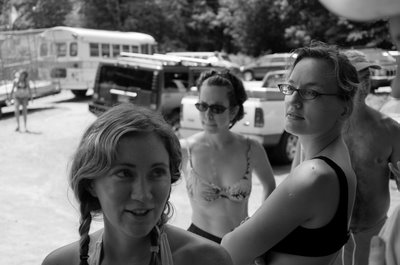
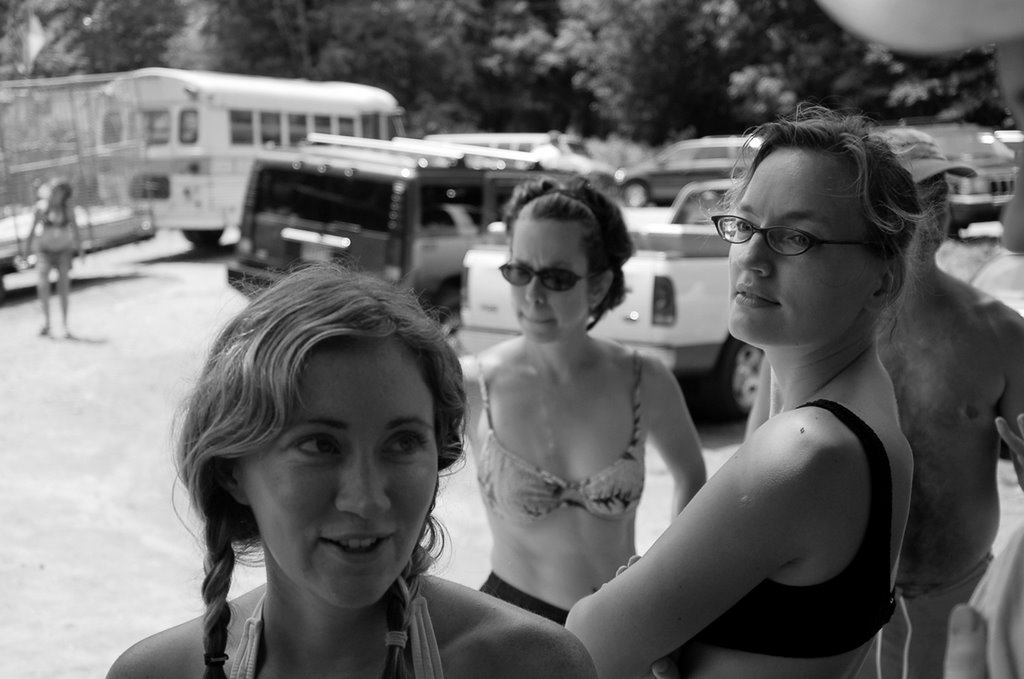
Saturday was the last day the State of North Carolina allowed alcohol on the Green River near Saluda so I went along with a colleague and a broo-ha of his neighbors from McDowell Street to spend an afternoon tubing down this quaint mountainy fleuve with a cooler of suds. Wicked hot, Saturday; er J-Sica might say hella hot, though I'm not much sold on either regionalism. Half way when I and those abreast had eyes peeled for a rope swing a storm blew in out of nizzle and the bright vernal sun got covered with bizzare dark like volcano ash. A squall line the size of eddies blew down the gorge ripping leaves off of hemlocks and sundry river bank species. The water was warm and until it rained I stayed in breathing the air which smelled of universal summertime. The rain came like swallows, chilled and abrupt, and urgent and deep. We huddled on the bank for some time before determining that the storm was not a typical temperate rainforest mountain storm like we often see but a real front, and by majority returned to the river road in the rain. this is what life is about i told the veterinarian and he nodded that's exactly right. i wouldn't want anything else right now he said and i watched the texture on the water change in torrent waves. Now the rain had grown temperate and came constant and smooth. shivering the afternoon progressed until we reached the landing point some hour later. The river ran higher and littered with leaves and branches. The water thickened with chalky muds and sand runoff from the banks hiding the oldest rocks in the world from the surface. All out, some without clothing or towel, and ruined keys upon the news of dinner at Green River Barbeque. Heather the Richly Accented gave an ode to sides. All came to Saluda, and ate, and rested, and returned to Asheville for books, and honeys, and lazy summer sleep among the dew and the crickets and the breezes in the trees outside of the windows.
Saturday was the last day the State of North Carolina allowed alcohol on the Green River near Saluda so I went along with a colleague and a broo-ha of his neighbors from McDowell Street to spend an afternoon tubing down this quaint mountainy fleuve with a cooler of suds. Wicked hot, Saturday; er J-Sica might say hella hot, though I'm not much sold on either regionalism. Half way when I and those abreast had eyes peeled for a rope swing a storm blew in out of nizzle and the bright vernal sun got covered with bizzare dark like volcano ash. A squall line the size of eddies blew down the gorge ripping leaves off of hemlocks and sundry river bank species. The water was warm and until it rained I stayed in breathing the air which smelled of universal summertime. The rain came like swallows, chilled and abrupt, and urgent and deep. We huddled on the bank for some time before determining that the storm was not a typical temperate rainforest mountain storm like we often see but a real front, and by majority returned to the river road in the rain. this is what life is about i told the veterinarian and he nodded that's exactly right. i wouldn't want anything else right now he said and i watched the texture on the water change in torrent waves. Now the rain had grown temperate and came constant and smooth. shivering the afternoon progressed until we reached the landing point some hour later. The river ran higher and littered with leaves and branches. The water thickened with chalky muds and sand runoff from the banks hiding the oldest rocks in the world from the surface. All out, some without clothing or towel, and ruined keys upon the news of dinner at Green River Barbeque. Heather the Richly Accented gave an ode to sides. All came to Saluda, and ate, and rested, and returned to Asheville for books, and honeys, and lazy summer sleep among the dew and the crickets and the breezes in the trees outside of the windows.
Subscribe to:
Posts (Atom)